
Tag Archives: #IWSG

The Joy of Writing & Knowing When It’s Time to Quit

The Insecure Writer’s Support Group

December 4 question – Let’s play a game. Imagine. Role-play. How would you describe your future writer self, your life and what it looks and feels like if you were living the dream? Or if you are already there, what does it look and feel like? Tell the rest of us. What would you change or improve?

 Rather than answering these questions, I’ve chosen to write about an important topic that came up this past month.

 The Joy of Writing & Knowing When It’s Time to Quit

Throughout my writing career, I’ve seen a few writers who have said, “I’m quitting. It isn’t fun anymore. I’m not selling anything. No one is reading my stuff.” And, then, they do quit.

I’m watching a writer friend saying that they’re giving up writing. Many are rushing to the writer’s side, saying, Oh, no! Don’t quit, or This makes me so sad. It’s nice that they’re being empathic; however, I don’t think these people are listening. This writer is stating a truth, and I believe this writer actually wants someone to say it’s okay to quit or that it’s okay to take a long sabbatical.

A few are saying so but the words are wrapped in subtle positivity where the message of it’s okay to quit is buried in words of You’re talented in so many areas, and Don’t stop being creative.

Yes, there is creativity in all of us. Some are creative with yarn, others paint, others still with trash. Many are creative with food, decorating, playing a musical instrument, singing, and so forth. So many outlets for our creativity.

No one, though, can do everything well.

It can take years of trying and learning before a specific craft or art form is mastered. So, it goes: we try, quit, and try something else until we find that thing that fills us with passion.

There are some writers, though, who get lucky and find their passion and monetary success in a short amount of time. Unfortunately, those are the writers who too many of us compare ourselves to.

That said, writing is not for everyone.

Writing is hard.

Even for those of us who love to write, there are days that it makes us want to scream and cry out, Why am I doing this?

The other day someone was asking me if I’m able to write every day because I’m inspired. Not really. Somewhere along the way, an idea inspired me, but to do the actual first-draft writing, I’m usually gutting out the words. We know these words aren’t great and even somewhat stinky, fodder for the compost pile of prose as they read first written. We stick with it, though, knowing that stinky first words must occur because once shaped, they can become something wonderful—material that others want to read.

Thus, while the original writing comes first, writing is really about the rewriting. Hours and hours of rewriting.

It’s about rewriting, revising, polishing, and proofreading. And, for the self-published…promoting.

These are the parts that most people enamored with writing don’t want to do. Because it’s hard.

We writers don’t write every day because we’re inspired. We write because we put ourselves in the chair, turn on the computer, and just write—one word, one phrase, one sentence, one paragraph, one page at a time.

The joy comes once we get into the zone and where time ceases to exist, which for me can occur after a few paragraphs or a smattering of dialogue. It’s just getting those first words down that is sooooo hard.

Writing is a solitary craft.

  • Write because you have a story to tell.
  • Write because it excites you.
  • Write because you’re amazed that you wrote that.
  • Write because if you don’t, you’ll be miserable.
  • Write because you have a truth to share, characters who want their voices heard.
  • Write because you need to share.
  • Write because there’s no alternative activity or craft that provides the same joy.

Write because you simply have to.

Write because you’re willing to do the work!

A writer should never compare themselves to any other writer. Especially the monies earned, or what we think they’ve earned. Did you know that the average income for a writer is about $5,000 or less per year? AVERAGE!

It’s no mistake that so many writers teach, coach, edit for others, and work at jobs centered around writing. It allows them to earn an income that’s compatible with their passion.

Ultimately, no writer’s journey is the same as another’s.

So, to that writer who is talking about quitting, I say:

Listen to your inner voice, your gut feeling. You and you alone know why you want to quit. If writing isn’t fun, it’ll only make you angrier and more frustrated in the future.

Give yourself permission to know what’s right for you.

There is nothing wrong with saying, this path isn’t for me anymore.

If there’s no joy in what you’re doing, you’re doing the wrong thing.

Me? I’ll never quit writing. I enjoy it that much, even the repetitive, time-consuming, polishing, and proofreading parts.

******

This year, Diana published Love’s New Beginnings and Tomorrow’s Wish for Love. She’s currently writing six novellas all at the same time because they are six couples with six stories, all living in the same community, and who are in and out of each other’s stories, which included the first novella, Shattered Dreams, that is already published. She’s working toward a 2020 publication for all six novellas.

******

Insecure Writers Support Group BadgePurpose: To share and encourage. Writers can express doubts and concerns without fear of appearing foolish or weak. Those who have been through the fire can offer assistance and guidance. It’s a safe haven for insecure writers of all kinds!

Posting: The first Wednesday of every month is officially Insecure Writer’s Support Group day. Post your thoughts on your own blog. Talk about your doubts and the fears you have conquered. Discuss your struggles and triumphs. Offer a word of encouragement for others who are struggling. Visit others in the group and connect with your fellow writer – aim for a dozen new people each time – and return comments. This group is all about connecting!

http://www.insecurewriterssupportgroup.com/

How to Redeem Unredeemed Gifts on Amazon

The Insecure Writer’s Support Group

For November 6, 2019

Rather than answering the question posed to the group this month, which was What’s the strangest thing you’ve ever googled in researching a story?, for which I had no good answer, I’ve chosen to write instead about a topic I needed to google, which then I wrote my own directions so I’d remember how to find the answer in the future.

Once I had the directions written, I realized there are probably other people out there, writers and non-writers, who have gifted Amazon books and not realizing the books may still be unredeemed.

Redeeming Unredeemed Gifts:

Putting Money Back into Your Amazon Account

Have you ever gifted a book on Amazon wondering if the recipient redeemed the book? Well, wonder no more.

The first time I followed someone’s directions to find that list of unredeemed books, I was shocked to find I had $84.00 worth of unredeemed books. Thankfully, I was able to follow this person’s directions and put that money back onto my account.

Recently, I gifted a book to someone living in India. Only after the fact did I learn that with my being in the United States, such a gift is unredeemable. Now, I had to undo my gift but I couldn’t find those same directions again. Plus, it had been a while, so all the online directions weren’t current either.

Figuring my way through a hodgepodge of different directions, I was able to undo the gift, putting the money back into my account.

As to the person I was trying to gift the book to. I asked for his Kindle email address and gifted it directly to his Kindle. Hopefully, that tactic should work. If not, I’ll be undoing that gift and will be sending him a Mobi file, instead.

At any rate, here are the directions I created, producing a document that I can easily follow in the future. I share the directions with you now, wishing you a great find of hidden cash in your account.

Directions

Once you’re signed in on Amazon, click on YOUR ACCOUNT. You’ll see this screen.

click on Your Account 1

Click on YOUR DEVICES AND CONTENT as shown above.

click on your devices & content


Click on MANAGE DIGITAL CONTENT as shown above.

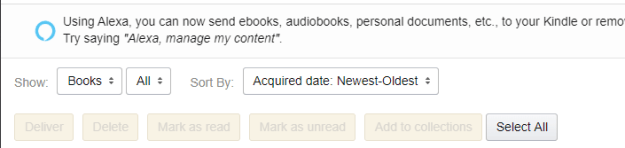
You’ll see a screen of all of your eBooks purchased and these menus at top of the list:

click on Manage Digital Content 3

Change BOOKS to GIFTS

click on Change Books to Gifts 4

You want to see GIFTS SEND: PENDING next to the GIFTS button, as seen below.

If you have any gifts that haven’t been redeemed, they’ll be listed, to which the following directions apply.

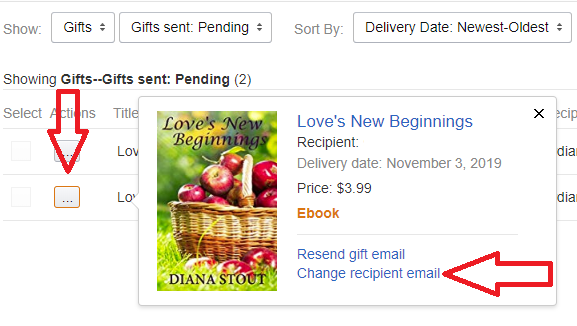
First, click on the three dots menus on the left side of the book title.

click on menu on left side 5.png

Then, click CHANGE RECIPIENT EMAIL.

(If you need to change the email address of a book gifted to a recipient, this is where you would make that change.  For instance, I’ve learned that I can send a gift directly to someone’s Kindle if they provide me their Kindle email address.)

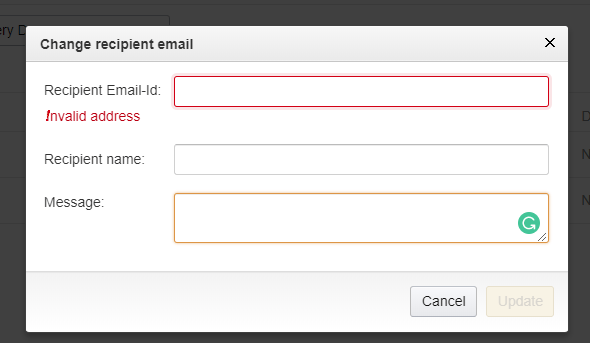
You’ll see this screen with the original recipient’s email-ID, their name, and your message if you filled them out.  Simply change the email address to your own, and click UPDATE.

click on change recipient email 6

You’ll receive an email stating you’ve received a gift Ebook.


Returning the Gift Money Back Into Your Account

Now to change that gift into Amazon credit, click on the button in the email.

click on Get Your Kindle book Gift now button 7

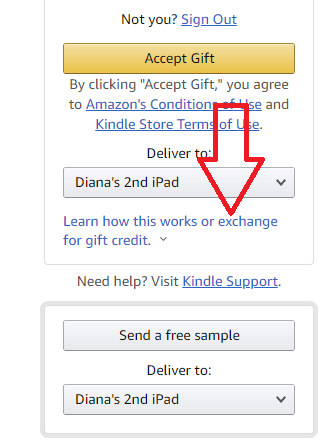
You’ll be taken to Amazon’s website where you can ACCEPT GIFT or LEARN HOW THIS WORKS OR EXCHANGE FOR GIFT CREDIT.

click on Accept Gift screen 8

This screen will open up and you want to click to REQUEST A GIFT CREDIT FROM CUSTOMER SERVICE NOW.

click on Request Gift Credit 9


Insecure Writers Support Group BadgePurpose: To share and encourage. Writers can express doubts and concerns without fear of appearing foolish or weak. Those who have been through the fire can offer assistance and guidance. It’s a safe haven for insecure writers of all kinds!

Posting: The first Wednesday of every month is officially Insecure Writer’s Support Group day. Post your thoughts on your own blog. Talk about your doubts and the fears you have conquered. Discuss your struggles and triumphs. Offer a word of encouragement for others who are struggling. Visit others in the group and connect with your fellow writer – aim for a dozen new people each time – and return comments. This group is all about connecting!

http://www.insecurewriterssupportgroup.com/

11 Reasons Why I Continue to Write

The Insecure Writer’s Support Group 

Posting for the first Wednesday of the Month, October 2, 2019

Because I’m in the final editing stages of my upcoming book, Love’s New Beginnings, which I plan on publishing in October, I thought I’d share some encouraging thoughts and moments I’ve experienced in my forty years as a writer.

11 Reasons Why I Continue to Write

Newly Published - July 2019

  1. Opening a box of newly published books never gets old. Never.
  1. If I don’t write, I get grumpy.
  1. I like to believe that one day I will be a best-seller author and have my story portrayed on the screen. At this point, I’m not fussy; while I had preferred the big screen, the little screen will do just fine.
  1. I get to hang out with other writers! And, they are the best people ever. They know how to spell! They laugh a lot. They know how to add to my idea, thus making it a great idea. They’re just as geeky about grammar as I am! They get me.
  1. I’ve become an expert in something: plotting, developing characters, writing, punctuations and grammar, writing loglines.
  1. I get to have geeky conversations on Facebook, such as whether the Oxford comma is needed or not. And, the conversations create more posts from one question asked than any political conversations elsewhere.
  1. Books and movies—old and new—get recommended.
  1. Diana's wall of booksIt’s okay that I have a lot of books. Lots.
  1. When writing, I enjoy losing track of time.
  1. It’s the only way I can get the voices out of my head.

Oh, and Reason #11 – Do I really need a reason when it’s pure fun?

Why do you write?

Insecure Writers Support Group BadgePurpose: To share and encourage. Writers can express doubts and concerns without fear of appearing foolish or weak. Those who have been through the fire can offer assistance and guidance. It’s a safe haven for insecure writers of all kinds!

Posting: The first Wednesday of every month is officially Insecure Writer’s Support Group day. Post your thoughts on your own blog. Talk about your doubts and the fears you have conquered. Discuss your struggles and triumphs. Offer a word of encouragement for others who are struggling. Visit others in the group and connect with your fellow writer – aim for a dozen new people each time – and return comments. This group is all about connecting!
http://www.insecurewriterssupportgroup.com/

Failures – Part IV: 7 Lessons of Failure as a Writer

This blog was originally published April 4, 2018, on my Only for the Brave blog, which has been eliminated as I decided to merge the two blogs. Because failure is an important part of success for writers and everyone else, I felt it was worthwhile repeating this post, this series on failure.

*****

7 Lessons of Failure as a Writer

People look at me and see success. Published in multiple media, in multiple genres, with various awards. With an MFA and a Ph.D., too, but there have been many failures along the way.

I have failed so many times I’ve lost count, from beginning, middle, and end.

In the beginning, I couldn’t get anything published. I tried big publications, national publications, regional, and small publications. All submissions boomeranged back. Once in a while, I’d get a handwritten note at the bottom of the mimeographed rejection, saying, I like your voice, or Please submit to us in the future. I learned from others these handwritten notes were excellent rejections because they were encouraging, that I needed do as suggested.

Only after a friend read a couple of my rejected essays and said, “This sounds like Erma Bombeck,” did I realize I needed to approach our local newspaper with a suggestion for a weekly or monthly column. Success! A six-month trial became a five-year career start.

Lesson #1 – If you can’t start big, start small.

When I turned to fiction writing, specifically romance, I already had a number of magazine articles and short story publications. I was reading a romance book a day, thinking how hard can it be? Over time, I found out. I wrote four books, all getting rejections. Even a published writer friend was amazed at the rejections, saying, “It’s like you’re standing on a cliff with only the back of your heels touching. Why aren’t falling off that cliff?”

The most devastating rejections occurred with an editor writing, “I just bought a book like yours last week.” So close, yet so far away.

At 37, I had been writing romances for nine years. I vowed that if I wasn’t published by the time I turned 40, I would quit.

I turned 40. More small magazine publications, but no books. I was getting closer, though. I was winning awards and placing in contests. I had an agent. Then I lost the agent, and then a second one. They were trying to put me into a publishing box I didn’t want to climb into. They were trying to make me into a specific kind of writer that I wasn’t and didn’t want to become.

At 42, I finally published my first book. Two more book publications quickly followed.

Lesson #2 – Don’t quit. Success will come but in its own time. Quit only if you truly have no more interest in pursuing that endeavor. Ever.  

About that time, I turned to scriptwriting. Producers were impressed with my book publications. While I did option one script to a producer for six months for no money, the option ran out. He wanted to renew for another six months, again with no money. I said no. About every two years after that, he would call me, asking what I’d done with the script. I knew I had a good story. (I’m in the process of rewriting and publishing that script now.)

In the meantime, I developed relationships with another five producers, all who loved my writing but couldn’t say yes to my scripts. It became a matter of trying to find the right material. They wanted me to submit anything and everything I was writing.

Lesson #3 – Rejections can be a yes.

One of my first book submissions was a colossal failure. The Senior Editor wrote:

Thank you for submitting BOOK TITLE for our review. We have found that your manuscript does not fit the requirements for PUBLISHER LINE. It is too melodramatic, based on trite misunderstandings among the characters as well as contrived circumstances. Sincerely . . .

So, she tore down the plot and conflict, the characters, the dialogue, and the…wait, there was no comment regarding the setting. Oh, wow, she liked the setting!

I used that setting in another book, with a similar conflict, different plot, different characters, and different dialogue. It sold and was published.

Going back to that rejected manuscript later, I could see that the editor was right.

The writing was horrible.  At least, she saved me from that humiliation. I had mixed tenses, multiple ping-pong points of view, mixed metaphors, wordiness, too much telling, and too many details that added nothing to the story or to the characters. The book was boring.

I should have burned the book, but I didn’t. I started looking at my writing from an editor’s point of view, and that’s when the real learning began.

Lesson #4 – Learn from your mistakes.

Never compare yourself to another writer. Not by their sales numbers, the number of books sold, how fast they can write, how few drafts they have to write, by their having an agent, or being traditionally published.

When you compare yourself to others, you’ll always be a failure.

Ironically, what you don’t see is that others are probably comparing themselves to you and feeling like failures.

Lesson #5 – Don’t compare yourself to others. Ever.

Their journey is not yours. Yes, some get lucky when they are young. Some get lucky with their first book. Some get lucky winning the highest awards. Some get lucky with their self-published book, earning thousands of dollars.

When I published my first book, I was in the right place at the right time. I had a once-in-a-lifetime opportunity to talk to an editor, actually being the first writer to talk to this editor, an editor looking to publish romances. He said, “If you know of anyone who has a manuscript, send them my way.”  When I told him that I had one, he invited me to send it.

He rejected it! Then asked if I had anymore. I did, I sent it, and he published it.

Lesson #6 – Luck is nothing more than a preparedness meeting opportunity.

I’ll never forget a writer who was angry about some contest scores she’d received. When I told her it wasn’t personal, she said, “It’s personal to me!”

I’ll admit that early in my writing career, rejections felt personal. When I started coming back to the rejection and analyzed what was being said more closely, I realized that everything said was true. So, how could it be personal? That criticism was helpful, meant to show me that I had areas that needed improvement.

Here’s the thing: As a writer, you can’t make it personal, all about you. I learned to step back and look at it from their point of view. If I’d been that agent, producer, publisher, reader, etc., I probably would have done the same thing.

Stepping into someone else’s shoes is how you don’t make it personal.

Lesson #7 – Rejections, failures, and criticism aren’t personal.

Failure means what you’re currently doing isn’t working.

That’s it. Nothing more. Nothing personal.

Step back. Rethink what you’re doing. Rethink the path you’re taking.

Then make a change.

Here’s the real secret. No two writers ever arrive at their level of success by taking the same path. It’s different for each and every one of us.

What’s your path going to look like?

The Surprising Secret of Developing Characters

The Insecure Writer’s Support Group

 The question this month is:  Has your writing ever taken you by surprise? For example, a positive and belated response to a submission you’d forgotten about or an ending you never saw coming?

 The Surprising Secret of Developing Characters

I’m such a plotter one would think that I’m never surprised. The truth is that with every story I’m always surprised. The words that come out of my characters’ mouths are smart, engaging, and laugh out loud funny. So much so, I’m usually laughing aloud while writing, with my laughter surprising those around me whether other writers at a write-in or strangers in a coffee shop.

Often, I find my characters’ banter doesn’t require tags because the characters each have a distinctive voice, so it’s easy to know who is talking. The advantage is because we know who is speaking tags aren’t required. Thus, the writing becomes action and dialogue, with some narrative now and then rather than all the time. Even then, I try to keep the narrative down to a minimum.

Once I know the bare-bones outline of a story—how it begins and how it ends—I spend a lot of time finding out who my characters are. Many writers will interview their characters wanting to know about their background: where they went to school, what’s their favorite color, favorite music, favorite TV program, and so forth.

To me, while I want to know my character’s physicalities—such as hair and eye color, height, their job, their tangible goal—it’s more important for me to know their pain, their wound(s), the deep dark secret they don’t want anyone knowing.

To discover this information, I become the character. I do so by writing character journals. I start out saying my (their) name, where they’re from, and so forth. These various details will take up half a page and then, suddenly, I (the character) will say something that begs a question of what do you mean by that, or what happened, or how did that make you feel? That’s when the character goes deep. By now, I’m talking (writing) in that character’s voice. My voice and my thoughts are no longer my own, but theirs. I’m seeing through their eyes, feeling their pain. And, the writing becomes a stream of consciousness in their desire to reveal everything that hurts. Everything that up until this moment, has remained a secret that they can’t live with anymore.

By the time they’ve run out words, I’m holding three-to-five single-spaced typed pages. I have their goals, their essence, their true character—not the one that others in the book get to see and have seen forever, but the one they struggle to overcome.

It’s that pain that drives the character, which in turn drives their response in word and deed, which then drives the plot forward. It’s these elements that then help me plot out the middle, the important emotional points that spin the story into different directions.

It’s that pain that becomes the character arc, the thing that the character must overcome in order to win the girl, get the job, get the prize, and to finally obtain self-respect. It’s the thing the character will no longer have to face in their future.

It’s character pain that attracts readers. They want to see how a character will resolve their wound because that wound could be their own.

It’s character pain that engages readers, that makes them turn the pages. The suffering, the action, the pain.

It’s the pain overcome that provides a satisfying end to any story regardless of how the story ends: happily ever after or bittersweet.

The secret of developing characters is much like an iceberg. It’s not about the ice we see above the surface, the ice a character has shown us up until now; it’s about the ice we don’t see, the ice below the surface, the ice we get to learn about. How deep that ice goes, how big of a problem the ice really is.

So, when it comes to developing characters, the secret I share with you is this: Go Deep.


Insecure Writers Support Group BadgePurpose: To share and encourage. Writers can express doubts and concerns without fear of appearing foolish or weak. Those who have been through the fire can offer assistance and guidance. It’s a safe haven for insecure writers of all kinds!

Posting: The first Wednesday of every month is officially Insecure Writer’s Support Group day. Post your thoughts on your own blog. Talk about your doubts and the fears you have conquered. Discuss your struggles and triumphs. Offer a word of encouragement for others who are struggling. Visit others in the group and connect with your fellow writer – aim for a dozen new people each time – and return comments. This group is all about connecting!

Personal Traits and Deepening Characters

The Insecure Writer’s Support Group

July question: What personal traits have you written into your character(s)?

Personal Traits & Deepening Characters

Currently writing a romance series of seven novellas, I’m starting the first draft of the fourth novella, Buried Hearts.

The first one, Shattered Dreams, is already published, with first drafts for the second and third, Burning Desire and Arrested Pleasures respectively written.

Because I’m writing the last first drafts of the last six before any more are published, it meant plotting the stories and creating the characters all at the same time.

Seven couples, seven romances, seven stories, with either the hero or heroine, if not both, all went to school together. Most were in the same graduating class, with two of them a class ahead of the rest. Some are best friends, some dated in high school, some wanted to date the other in high school but didn’t.

In Buried Hearts, Clint Anderson, a life-long resident of Laurel Ridge where all the stories take place, is giving a fiftieth wedding anniversary party for his parents and has hired balloonist, Gabriella (Gabby) King. He gets to know Gabby during the flight with his parents, and he’s smitten.

A long time ago, I learned when developing strong and interesting characters, I need to go deep. Down into the dark where their secrets are hidden. Secrets they haven’t talked about and feel ashamed to let others learn.

I learned that those secrets, those wounds drive that character. That secret determines how they act, what they do, what they wish for. Because I know all these things before I write word one, I’ve become a monster plotter.

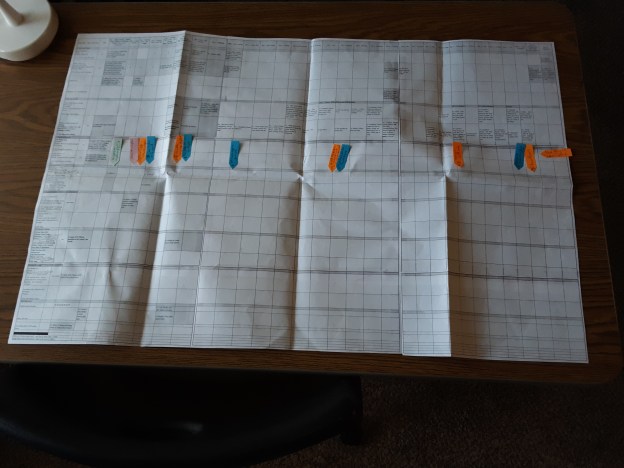
Because all seven novellas take place within the same time period, I’m now in the process of plotting out their events on a monster spreadsheet. Did I tell you how much I love spreadsheets?

Plotting spreadsheet

Insecure Writers Support Group BadgePurpose: To share and encourage. Writers can express doubts and concerns without fear of appearing foolish or weak. Those who have been through the fire can offer assistance and guidance. It’s a safe haven for insecure writers of all kinds!

Posting: The first Wednesday of every month is officially Insecure Writer’s Support Group day. Post your thoughts on your own blog. Talk about your doubts and the fears you have conquered. Discuss your struggles and triumphs. Offer a word of encouragement for others who are struggling. Visit others in the group and connect with your fellow writer – aim for a dozen new people each time – and return comments. This group is all about connecting!