
Category Archives: writing

The Secret Joy of Writing & When Lightning Strikes

Every business has practices that participants try to follow, believing they are best practices.

Writing is no exception. Large numbers of blogs and books are written on how to launch a book. And, each includes a long checklist that starts months before publication. After publication, there’s more promoting: newsletters, more blogs, book signings, blog tours, social media participation, ads, and more.

Not to mention, joining writing organizations, attending conferences, subscribing to newsletters, and taking classes.

Truthfully, the list of things a writer should do, whether indie or traditionally published, is overwhelming.

Most writers say their joy comes from the writing. I don’t know of a writer, yet, who says they love promoting their books.

I’m no exception. My joy comes from writing, teaching, and helping other writers.

After much analysis of how I spent my time in 2023 (60% promoting, 30% writing, 10% everything else), I realized that to flip those numbers, I needed to make drastic changes. I began asking questions like, Do I really want to do this? Do I need to do it?

I concluded that…

I’ll do book signings when readers clamor for them.

I have a newsletter, but it’s an announcement-only newsletter, which means I send them out only a few times a year. Producing a regular newsletter doesn’t work for me.

I’m on social media, but I don’t like doing videos or podcasts. So, I’m highly active on only a few platforms.

I still have big goals, but better yet, I have great writing habits that move me toward achieving them.

As a result of my changes, in 2024, I spent 80% of my time writing and 10% promoting. Because I believe a backlist is important, I wanted to produce more.

Finally, I stopped comparing my activities to other writers. I allowed myself to be different, to do me. Now, I only compare myself to how I’m doing this year compared to last year.

And when I read a book from an unknown (to me) author, I took comfort in later discovering her method was even more extreme than mine.

—

The Tale of One Author Who Did It Her Way and Still Does

After I read one book by this author, a book she’d published after about 15 other books, I learned she had written about 24 books total, so far. I found her 30,000 members strong fan group of mostly readers and some writers and joined.

I began reading her earlier books. While they weren’t as riveting as the first one I read, as I moved through her backlist, I could see how her writing improved.

Her print and eBooks were sold only through Amazon. She was an indie author who did no book signings, no interviews, no publicity, and minimum advertising on Amazon.

Suddenly, her fan base blew up and her books started hitting the best-seller lists. At one time, she had three books in the top ten. Publishers began seeking her out, republishing her books.

Now, her fan group has 170,000 members. She has two publishers with print books everywhere and audiobooks online in libraries. She continues to be in the top ten of the best-selling lists, and she still participates in her Facebook group where she started. She’s vowed her eBooks will always remain in Kindle Unlimited. Today, she has an agent, and her most popular book is being made into a movie.

While she doesn’t do book signings, she does sign books that are sold through the bookstores, plus she sells bookplates that are signed. They’re just one product on her website, products readers requested,

Lightning struck because she authored great stories readers wanted to read. She wrote for pure enjoyment, then started publishing them just to share. She wasn’t interested in making money; she already had a career—as a doctor.

She did her.

She’s my role model.

Her name is Freida McFadden.

While I’d love to be earning a living from my writing and don’t have a secondary career anymore, I’m doing me and trying to manifest my own lightning strike. Thus, my focus is to author great stories and to share what I’ve learned. Hopefully, one day, I’ll have a rabid fan base, as well.

In the meantime, I’m excited every time I open a box of newly published books and find immense joy in the writing.

—

Your takeaway: Take time to try different activities, but stick to those activities that are a good fit energy- and money-wise for you. Activities that leave you feeling joyful and excited to be a writer.

Let No One Destroy the Dream Maker

Martin Luther King, Jr. said, “No person has the right to rain on your dreams.”

I had a best friend who claimed to be a romance writer, though she never finished a story that I knew of, never submitted anything, and spent more time quilting than she did writing. She liked to talk about writing, though, and she was great at brainstorming.

When I became interested in screenwriting, she did, too. She liked coming up with ideas. Then, I began working with half a dozen different producers who liked my voice, liked my writing. They wanted to see anything and everything I wrote. It became a matter of finding the property that would be a good fit for them.

When I optioned a screenplay with a Canadian producer who had ties to Hollywood, she told me it wouldn’t go anywhere. She stated that I’d never sell a script because I didn’t live in Hollywood, wasn’t young enough, and wasn’t the right sex.

I was in my 40s!

I asked her why she would stomp on someone’s dreams like that?

Crickets.

Later, I discovered her mother had stomped on her dreams of being a clothing designer. So, she became an office assistant for NASA, a job her mother approved of but which my friend hated. She retired as soon as she possibly could. Quilting, a part-time hobby for much of her life, now became her full-time hobby, along with the care of her many cats.

While that optioned screenplay ended up not going anywhere—which is true for many optioned screenplays—just getting it optioned was an enormous step in the multi-step process of a script being filmed.

I still have hope for that script. Why?

Because it performed decently in contests and still garners excitement when I’m asked what is it about and I provide its logline pitch. Currently, it’s a project that needs a facelift.

And now, after a 30-year hiatus from screenwriting—due to a divorce, a return to school, and a career of academic teaching, during which I was writing Grendel’s Mother, retired, and became an indie publisher of 20 books, I’m finally back.

In coming back, I’ve rejoined Scriptwriter’s Network, a screenwriting organization I belonged to decades ago, during which I judged their screenwriting contests for a decade.

As a result of coming back, I’ve been invited to do a webinar on October 19, with the Network’s president who is hosting the event. I was thrilled to be asked and am honored to present and hopefully help other writers.

I feel like I’ve come home.

Back when my best friend stomped on my dream, I knew her stomp wasn’t about me. It was all about her. She wanted me to live the same script she was forced to live. The adage of misery likes company was the subconscious core of her words.

She wasn’t the only one who tried to talk me out of my creative writing or going back to school. They all said the same thing: that I was wasting my time, wasting my money. There were others, but her voice was the loudest and most consistent.

I ignored the advice and continued onward, listening instead to the little voice that had cheered me on, whispering that it was okay to follow my passion. I knew from experience that my little voice was never wrong.

My dreams were about publishing books, being able to help other writers, presenting, becoming an acclaimed screenwriter and best-selling author. So far, I’ve achieved most of my goals. The big monster goals are still goals to achieve, but I continue to work and strive toward them. Always listening to that little voice from within.

When my stepfather was nearing the end of his life, we had a great many talks about life, and I asked him if he’d had any regrets. Immediately, he replied with a sad, resigned expression, “I wish I had lived my own life, making my own decisions.”

Don’t let others stomp on your dreams. Age doesn’t matter. Follow your passion, and if that passion doesn’t pay the bills, take whatever day job(s) that will pay your bills, while you pursue your passion at the same time. Having other responsibilities can slow you down, as it did me from time to time, but the key is to never give it up.

It’s never too late to start. The joy you receive is beyond words. You’ll never regret the pursuit.

I sure don’t regret the unusual path I took. While it hasn’t always been easy or always fun, it’s been interesting and lesson filled. And, I’ve met a lot of incredible people along the way. Every success, no matter how small, has been a win.

Currently, I’m writing a psychological paranormal thriller novel and plan to publish it by the end of the year; plus, I plan to write it as a screenplay, too. Other screenplays will follow, along with a continuation of my Finding Your Fire series.

What about you? Are you living the life you always desired? Are you ready to start living that life now, even if only for fifteen minutes a day?

Best-ever New Thesaurus Is Here! (+ Giveaway)

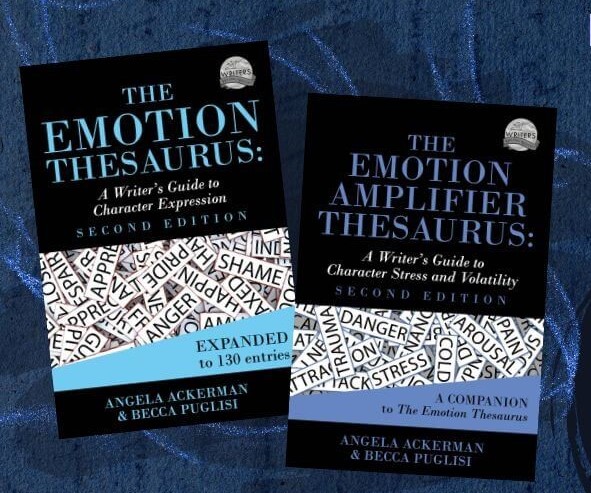
I’m sharing Angela Ackerman and Becca Puglisi’s big day! The Emotion Amplifier Thesaurus: A Writer’s Guide to Character Stress and Volatility has just released, and as part of the Street Team, I’m helping to get the word out about a HUGE giveaway Angela and Becca are running to celebrate!

This guide is a companion to the popular Emotion Thesaurus and covers all the ways to push a character emotionally, setting them up for BIGGER reactions.

Emotion Amplifiers are specific states and conditions that can strain a character to the point they lose control. Pain, exhaustion, arousal, and competition are just some of the amplifiers that can send your character over the edge. If they give in to what they feel, they might lash out, take foolish risks, show poor judgment, and act in ways that take their situation from bad to worse. Hello, conflict!

Win A Free Workshop!

Amplifiers can bring a character’s emotions to the surface for readers to see, which is exactly what we need to happen. But that’s not all they do. Becca and Angela can’t wait to dive into how they can power a story and are celebrating this release with a very special Zoom workshop.

100 Seats Are Up for Grabs!

If you’ve ever attended a workshop by Angela and Becca, you know you’ll learn a ton. Head over here to enter the giveaway, but hurry – the last day to enter is May 17, 2024.

Good luck!

Are You a New Writer?

The Insecure Writer’s Support Group

The January 3 question: Do you follow back your readers on BookBub or do you only follow back other authors?

Are You a New Writer?

Rather than talk about who I follow on BookBub, because it’s the new year, I decided to address new writers, instead. I guess that’s the teacher in me: new year, new semester, ­new students.

I remember back to when I was a new writer, too. What I share with you are the things that best helped me as a new writer.

Read anything and everything. Read from writers you admire, notice their style, their voice. Read specific genres. Read across the genres. Read all the how-to books you can. Not only the newest publications, but older books, too.

Write a lot. Don’t worry about structure with your first drafts. Don’t edit or delete; just write. Write scenes of your desired genre. Or, just write whatever comes to mind and not worry about genre. Don’t worry about completing a book at this point. Instead, concentrate on making the dialogue sound true and creating believable characters.

Follow writers you admire. Learn about their process, any advice they offer. Take everything with a grain of salt, however, because no two writers follow the same process.

Subscribe to writing newsletters and writing blog; they’ll provide how-to information you need. Use that which sounds good for you.

Look for a critique partner or critique group you can join. In the beginning, you’ll be swapping writings with anyone and everyone. In time, you’ll want to vet them just as they should be vetting you. You want someone who will be honest, telling you what doesn’t work and why. Ideally, you want someone who writes in your genre or is knowledgeable about your genre.

Above all else, be open to hearing comments about your work and suggestions of how you can improve it. You don’t have to like everything suggested or even use it; and, don’t defend your work either. Just say thank you. What they provide and how they provide it will determine if you want to continue critiquing with them.

Attend conferences and make connections. Attending a conference is no place to be shy. Introduce yourself and then ask about their writing. People love to talk about themselves! Create elevator pitches, too. Don’t know what they are? Google elevator pitch. If you go with a group, don’t sit with them at every event. Sit away from them from so you can meet new people.

Create a business card. Make it simple. List yourself as a writer with contact information. That’s all you need.

Don’t think about a publisher or agent, yet. It’s too early. You’re just getting started. That said, any opportunity to hear an agent or publisher talk, sign up! Call it research; it’s a way to determine what kind of agent you want and what kind house you want to publish with. Don’t discount becoming an indie publisher, though. Do the research to compare your options.

Enter contests: local, regional, and national. Choose those that provide some kind of feedback. Consider who’s judging the contests, too. Consider if you were to win, would you get to meet with an agent, publisher, or production companies?

Find a writer’s group nearby or online and attend regularly. Check out past meetings to see what presentations they offered. You want a writer’s group that will help you grow as a writer, a group that provides you with quality takeaway.

If you are in a writing group, consider becoming a volunteer. It’s a great way to make connections. However, any volunteer work you do will take time away from your writing. Be prepared.

Learn and master basic grammar and punctuation. Both agents and publishers want polished work; meaning, reasonably clean work, not work riddled with errors on every page.

And, I can’t repeat this direction often enough: WRITE A LOT! The more you write, the better you’ll become. Practice writing is no different from practicing the piano, hitting the ball, or riding the wave. Dedicated, regular practice improves!

Check out my Recommended Reading page on my website! I’ve got a great list of how-to resources and am adding to the list every month.

And, one last reminder about my two-week Master Class, Punctuation and Grammar Made Easy, starting Jan 6, 2024 with limited seating. So, sign up now! There may still be a seat or two left.

*****

Dr. Diana Stout appreciates her readers and fans and would love for you to sign up for her announcement only newsletter. She promises that your mailbox will love you because the newsletter is only sent out with new release information, discounts, freebies, and giveaways. And, if the season is right, she might provide a recipe from her own cookbook.

Learn more about Dr. Stout at her website, Sharpened Pencils Productions.

*****

Purpose: To share and encourage. Writers can express doubts and concerns without fear of appearing foolish or weak. Those who have been through the fire can offer assistance and guidance. It’s a safe haven for insecure writers of all kinds!

Posting: The first Wednesday of every month is officially Insecure Writer’s Support Group day.

How to Stay Positive

The Insecure Writer’s Support Group

Instead of answering this month’s question, which is an AI question, I queried a writer friend and asked, What would you most like to read about in a blog right now? Her response was, “Staying Positive.”

How to Stay Positive

As writers, when the world’s toxicity seeps into our homes, our thoughts, and feelings, writing can become more difficult. It’s harder to concentrate, to focus.

So, what can you do to stay more positive?

  • Take a shower. Let the toxicity go down the drain!
  • Create a playlist that lifts your spirits and matches the mood of your current work in progress and play it when writing.
  • Take a walk in nature. Listen to the sounds, become one with nature.
  • List things you’re grateful for every day.
  • Start a positivity diary. List of all the good things that have ever happened in your life. Keep that list handy and keep adding to it. Refer to it as needed.
  • Don’t drink. Alcohol is a depressant.
  • Journal. Write your feelings out on paper. It’s about opening the dam of feelings and thoughts, venting on paper. Afterward, burn it, shred it, or tear into tiny pieces and flush down the toilet. Or, save it, and give those feelings to a character!
  • Stop worrying—99% of what we worry about never comes to pass.
  • When tired, take a nap or take a break.
  • Do something different.
  • Find a way to laugh. Start saving funny videos. Follow those people! Watch a comedy series or a funny movie.
  • Do a search for flash mob dances or orchestras on social media.
  • Dance! Alone for the length of a song.
  • Blow up an imaginary balloon, blowing your feelings, thoughts, and problems into the balloon. Then, release it to the Universe. Imagine yourself outside, seeing it rise above the houses and disappear into the clouds.
  • Perform some self-talk.
  • Plant something. Get your hands into the soil.
  • Go to a playground and swing or play in the sandbox.
  • Spend time with people who make you laugh, with whom you feel good about yourself when you leave their company.
  • Put positive affirmations on your bathroom mirror, at your desk, or in other places that you frequent and will see often. Change them up as needed.
  • Give someone a compliment.
  • Don’t take things personally.
  • Drive a new route home.
  • Buy yourself some flowers.
  • Do something differently. Drive a different route, go into an unknown store.
  • Eat out alone with a book. Enjoy your own company.
  • List goals you want to achieve. Break down a goal into manageable chunks—something you can do in 10 or 15 minutes. As you achieve them, cross them off!
  • Remove the triggers!

One of the best things I did to stay positive was to remove anything in my home that triggered me, immediately taking me back to a toxic event or conversation, which I started reliving, noticing my feelings and thoughts became a downward toxic spiral. Even though I had reconciled or had moved past it! Those triggers included clothing, knickknacks, furniture, and especially photographs.

Staying positive requires action on your part.

We are what we say, what we think, and what we DO!

*****

Purpose: To share and encourage. Writers can express doubts and concerns without fear of appearing foolish or weak. Those who have been through the fire can offer assistance and guidance. It’s a safe haven for insecure writers of all kinds!

Posting: The first Wednesday of every month is officially Insecure Writer’s Support Group day. Post your thoughts on your own blog. Talk about your doubts and the fears you have conquered. Discuss your struggles and triumphs. Offer a word of encouragement for others who are struggling. Visit others in the group and connect with your fellow writers. This group is all about connecting!

A Writing Career Path: Finding the Joy

While writing a book wasn’t the start of my writing career, I do remember when I decided to write a book and how the excitement of possibilities appealed to me.

At the time, I was reading a book a day—mostly romances. Those slim, Silhouette and Harlequin romance books that had new titles every month. The books read fast and left me feeling good and filled with hope.

How hard could it be to write them?

Actually, it was way harder than I had imagined. While it looks easy, it really isn’t. It took me a year and a half to write that first book. Selling it was another matter altogether.

It took writing five books to learn about determination, needing a plan (more like an outline), diligence, and sheer grit. Along with agony and disappointment.

I was writing the first few books in an era where there were no computers, only typewriters. Where you had to have an agent in order to submit your manuscript to the publisher. And, where all manuscripts were mailed via USPS, where it could take months or a year to hear back from the agent, let alone the publisher.

Thankfully, the computer came into being amid writing those books. Rewriting became easier. Not much else became easier, though.

Early in my career, I was successful in writing short nonfiction via a newspaper column and then magazine articles. Writing nonfiction, whether creative nonfiction, academic, or technical came easy and still does. I was published in nonfiction within a couple years.

Writing fiction, however, was much harder and required a lot of trial and error. I wrote piles of romance short stories before attempting my first novel.

I remember taking one of those Harlequin books and wrapping it using the brown paper from a paper bag like we used to do with school textbooks, and I put my book’s title on the cover along with my name. I planted that book in front of my typewriter.

I had a goal.

It would take 12 years before I would publish my first book. I nearly gave up in the 10th year. Why? I had sworn that if I hadn’t published a book by the time I was 40, I’d stop trying. When I turned 40, I was too close to quit.

In fact, one author friend said, “Diana, it’s like your heels are on the edge of the cliff and yet you don’t fall off the cliff. I don’t get why you aren’t published.” My heels had been on that cliff for over seven years.

I didn’t get it either. I’d had two agents come and go, I placed in contests, and every editor said they loved my writing, but…

At 42, it took my being in the right place at the right time to connect with an editor whose publication house was entering the romance genre for me to become a published author. My book was their introduction into the field and they hyped that book heavily.

Two more books published with another house followed quickly, with a sale of a fourth book to yet another house.

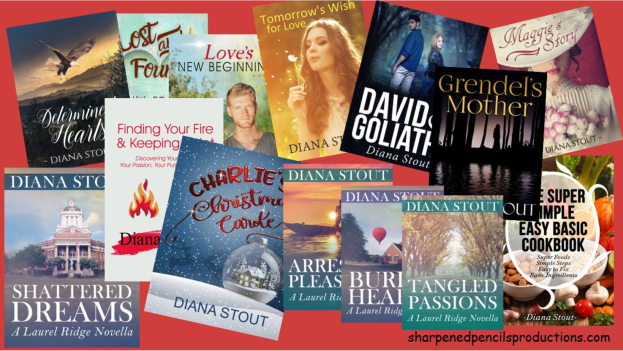
Since then, it’s been a fun-filled journey of writing—screenplays, stage plays, poetry, academic writing, a dissertation, more contests, more awards, blogging, and becoming an indie publisher where I’ve now published 14 books, with plans for several more publications this year; Tangled Passions, the fifth book in a series of seven was published on Valentine’s Day.

My writing career has endured the highs and the lows for over fifty years, and finally, after much experimentation and meeting various challenges, I’m finding the genres where my writing joy truly thrives.

Looking back, I’m grateful for the entire journey. It’s been quite the process where the joys outweighed the disappointments. Even the frustrations were short-lived.

May everyone experience such joy.

*****

This year, Dr. Stout expects to publish the last two romance novellas in the Laurel Ridge Novella series, a writer’s resource book, a historical Gothic romance for an anthology, along with a comedy screenplay. Additionally, she’s plotting a Gothic novel and finishing up several other writer resource books. In June, she’ll be teaching a two-week Master Class, “Using (& Avoiding) Procrastination.” To learn more, click here. If interested, sign up soon! Class is limited to 25.

*****

Purpose of The Insecure Writer’s Group: To share and encourage. Writers can express doubts and concerns without fear of appearing foolish or weak. Those who have been through the fire can offer assistance and guidance. It’s a safe haven for insecure writers of all kinds. Posting: The first Wednesday of every month is officially Insecure Writer’s Support Group Day. Post your thoughts on your own blog. Talk about your doubts and the fears you have conquered. Discuss your struggles and triumphs. Offer a word of encouragement for others who are struggling. Visit others in the group and connect with your fellow writer – aim for a dozen new people each time – and return comments. This group is all about connecting.

Teaching again…

Squeeeeeee! I’m going to be teaching again!

The class is Time Management for Writers; and actually, the class is applicable for anyone who struggles with managing their time. The principles and science are the same for everyone, regardless of their career or goal(s) they’re trying to reach.

The class takes place February 1-25, 2022, via email. Registration is located on the WritersUniv.com web. Click here for details.

Anytime I’ve been able to teach anything about writing—whether it’s creative writing or the business of writing, regardless of genre—I’m having a good time.

I enjoy sharing information. I especially enjoy watching the light bulb reactions that my students and participants have when they get it.

I enjoy watching empowerment happen. The expressions of joy I’ve witnessed is inspirational. I always smile watching someone’s confidence rise because they’re mastering a skill they never thought they had or were told they never would have.

I enjoy learning from others. I learn as much from my students and workshop/roundtable participants as they learn from me! I’ve even been corrected from time to time. After all, information is not always static. Improvements and new information are made and found all the time.

I’m even toying with setting up some live Zoom meetings, where I teach creative writing/business writing in two-hour workshops. Maybe even set-up some free Q&A/discussion sessions. There are so many writing topics that could be covered! What do you think?

A Necessary Evil: Feeding the Writer

A Necessary Evil: Feeding the Writer…with a Chicken & Stuffing Casserole

I’m one of those writers who wants to go into the kitchen and ten minutes later be eating a solid meal. Second to that, I’m good with a dish that I can cook and still be eating several days later.

While I’m a decent cook, it’s not my passion. Nor, do I like being in the kitchen every day. Every few days is my preference. Cooking for one makes that easy to do.

Now that I’ve been diagnosed with celiac (can’t eat gluten), with a long list of allergies that includes all dairy products, (No more butter? NO!), finding substitutes for my beloved pre-celiac dishes has been a challenge. Thankfully more companies are producing gluten-free and dairy-free products.

(I highly recommend Country Crock’s Plant Butter made from almonds. It spreads like butter and even better, it tastes like butter!)

One such product that I discovered just before Thanksgiving was Savory Stuffing by Aleia. While I still miss the traditional crouton stuffing, this one tastes pretty good. Aleia has a box of plain stuffing croutons, as well.

I’m now using this savory stuffing, along with traditional stuffing ingredients and chicken to create a one-pan, one-dish meal.

The thing is, this recipe can work for anyone. Just substitute your preferred croutons and butter for mine, plus you can use more or less vegetables as desired. I like lots, so I actually use more than the recommended 1 cup.

My gluten-free, dairy-free recipe:

  • 1 box Aleia Savory Stuffing mix
  • 1 cup chopped carrots
  • 1 cup chopped celery (I’ve discovered I can freeze chopped celery!)
  • 1 cup chopped onion
  • 5 T Almond Plant butter
  • 1.5 cups of chicken – I use whatever is handy: canned or leftover cooked
  • 2 cups of chicken or vegetable stock
  • Salt & Pepper to taste

Melt the butter in a large frying pan. Saute the carrots, celery, and onion until the onion is translucent and the vegetables are tender.

Mix everything in a large bowl, until the stuffing is moistened and all is thoroughly mixed. Pour into a baking dish.

Bake at 350, covered with foil, for 20 minutes.

If you want a crispy crust, bake for about 15 minutes, remove the foil and bake for another 10 minutes or until top is crusty to your preference.

To serve up as leftovers, dish desired amount into a bowl, add some chicken gravy and heat in the microwave for about 1-2 minutes or until hot.

***

I had two bowls of this dish tonight, barely making a dent of the total amont. I now have leftovers for the rest of the week. And, I’m willing to eat this for both lunch and dinner if it means not having to fix anything else for the week, adding a salad here and there, along with eggs for breakfast. 

How about you? Do you have a favorite dish you like to make while you’re writing that allows you to forget about cooking for a few days?

Characteristics of the Working Writer

The Insecure Writer’s Support Group

October 7 question – When you think of the term working writer, what does that look like to you? What do you think it is supposed to look like? Do you see yourself as a working writer or aspiring or hobbyist, and if latter two, what does that look like?

Characteristics of the Working Writer

I’ve been a working writer since I was 26 years old with a newborn and a toddler. From the beginning, my goal was to earn an income from my writing. That made me different from the hobbyist writer.

According to IRS, a hobbyist writes for pleasure, for fun, not to make a profit. The working writer is trying their best to earn an income. The IRS has nine factors to judge whether you are a hobbyist or a working writer:

Question:  How do you distinguish between a business and a hobby?

Answer:  In making the distinction between a hobby or business activity, take into account all facts and circumstances with respect to the activity. A hobby activity is done mainly for recreation or pleasure. No one factor alone is decisive. You must generally consider these factors in determining whether an activity is a business engaged in making a profit:

  • Whether you carry on the activity in a businesslike manner and maintain complete and accurate books and records.
  • Whether the time and effort you put into the activity indicate you intend to make it profitable.
  • Whether you depend on income from the activity for your livelihood.
  • Whether your losses are due to circumstances beyond your control (or are normal in the startup phase of your type of business).
  • Whether you change your methods of operation in an attempt to improve profitability.
  • Whether you or your advisors have the knowledge needed to carry on the activity as a successful business.
  • Whether you were successful in making a profit in similar activities in the past.
  • Whether the activity makes a profit in some years and how much profit it makes.
  • Whether you can expect to make a future profit from the appreciation of the assets used in the activity.

An additional determination is whether the writer keeps separate bank accounts of business versus personal and if records are kept regarding their hours, projects, and submissions.

Five-hundred hours is the dividing line between hobbyist and working writer, too, and whether these hours are documented. How do I know?

When filling out a Schedule C through Turbo Tax, I was asked the question: did you work 500 hours this tax year in this business?

Five hundred hours per year equals just under 10 hours per week or almost 42 hours per month.

A working writer makes time or schedules writing time.

In my opinion, all three types of writers attend conferences, read how-to books, and ask questions, and love to talk about writing.

This list is what I believe are the differences:

Aspiring Writer

  • thinks about writing
  • doesn’t keep business records
  • asks questions in any group, thus doesn’t do any of their own research to learn the answers
  • are quite active in online groups
  • writes a little

Hobbyist Writer

  • writes when feels inspired, which means not every day
  • doesn’t keep good business records
  • likes to talk about writing
  • asks questions of other writers in those group of their genre, has done some research but relies on the other writers’ responses

Working Writer

  • writes nearly every day or per a planned schedule
  • writes even when not inspired; they know they’ll be in the zone soon.
  • writes even when sick, a loved one has died, divorcing, or some other life event has appeared in their life. They find solace in their writing.
  • has reams and files of their work even if not published
  • usually not in various online forums; if they are, they rarely read the posts or respond; they’re busy writing!

Purpose: To share and encourage. Writers can express doubts and concerns without fear of appearing foolish or weak. Those who have been through the fire can offer assistance and guidance. It’s a safe haven for insecure writers of all kinds!

Posting: The first Wednesday of every month is officially Insecure Writer’s Support Group day. Post your thoughts on your own blog. Talk about your doubts and the fears you have conquered. Discuss your struggles and triumphs. Offer a word of encouragement for others who are struggling. Visit others in the group and connect with your fellow writer – aim for a dozen new people each time – and return comments. This group is all about connecting!

How to Write When Struggling – Part II

Making Changes Can Make a Difference

Writers write in the best of times: when they’re healthy, working full-time, parenting, maintaining their homes, special celebratory events, births, and socializing.

They write in the worst of times: when ill, laid off, dealing with toxic neighbors or family, moving, and deaths.

And then there are the anormal times, such as the one we’re currently dealing with: Covid-19.

Up until now, I’ve been able to write through anything. I’ve written in playgrounds, noisy coffee shops, airports, and complete silence. I’ve written through two divorces, several moves, even the loss of jobs. I’ve written when sick with colds, fevers, stomach cramps, aching limbs, short-term migraines, and other ailments. However, having the flu for the third time in six weeks, three-day migraines I used to have, and vertigo have been the exceptions. Anytime my eyes are affected or when I’ve been lain out flat from an illness wishing for death, the actual task of putting words on paper or screen becomes non-existent.

One would think that during this current pandemic, especially while in lockdown, writers would be celebrating this huge chunk of solitary time, time they’ve wished for.

Surprisingly, despite the fact that I’m a full-time writer, I discovered I was struggling. So were many of my writer friends, plus thousands of other writers who are in my online writing groups.

For the second time in my life, I found myself facing depression even though my life wasn’t changing much. The things that changed for me were meeting friends and other writers in person and book club meetings.

While I’m not an expert on depression, from what I’ve read and researched, my depression came from loss. A loss of routine. The loss of physical connections. For me, the pandemic was a profound distraction, not to mention the fear of getting the virus.

Even though it was heartening to learn I wasn’t alone, it didn’t my problem.

After struggling through March and April of little writing or even the ability to concentrate on the most mundane of things, like paying bills or doing laundry, and feeling like every little task was a monster chore, I was ready for a mental spring cleaning.

I wanted to write again, and now, I am. So, what changed?

1) Recognizing Concentration Limits

During this pandemic, my ability to concentrate for long periods of time diminished greatly. I discovered if I did 15-45 minute sprints, I could do 1-3 sprints a day and write about 300-700 words per sprint, depending on the material I was writing.

2) Obtaining Accountability

I’ve always tracked my writing: how many words, how long, the tasks completed. Now, I’ve added an accountability partner. We check in with each other in the morning with either a live chat or a Messenger message, naming our goal(s) for the day. Then, we check in with each other in the evening, reporting what we’ve done.

Most of the time, we’re making forward progress.

On the days, where we did next to nothing, we acknowledge that we’re allowed. We’re exhausted, been injured, or just needed a day off.

The accountability works because 1) we’re verbalizing our goals and 2) we’re cheering each other on with positivity. It makes us want to do more!

3) Making Good Food choices

Since learning a year ago that I had a pile of allergies. celiac disease, and a high inflammatory rate, I changed my diet in big ways: avoiding the allergen foods and eliminating all grain, dairy, and sugar. I was doing well: losing weight and reduced my inflammatory rate to near zero. In fact, when I had one minor surgical procedure done last fall, the doctor expressed surprised at how fast the wound had healed. Additionally, all my aches, pains, and psoriasis had disappeared.

In February, I started cheating with just a couple foods. Then in March, April, and May, I jumped into the rabbit hole of unhealthy eating. No restrictions. All my previous comfort foods were back: ice cream, mac and cheese, cereal, sweets, and bread.

By June I was paying for those dalliances. All the previous ailments had returned and I was suffering, including gaining back all the weight I had lost.

Now, I’m eliminating all foods that are poisonous to my body again. I’m feeling better and I’m losing weight…again. The returned aches and pains are disappearing.

4) Connecting with Family and Friends

With all my writing meetings and weekend write-ins getting cancelled, online meetings became the next best thing. We can talk, laugh, and share our screens as we talk about the craft and continue to help each other with writing and publishing issues.

In fact, our monthly meeting this past Saturday was an all-day online write-in. We met in the morning, checked in a couple hours later, and then, checked in at the end of the allotted time. Everyone had met or were close to meeting the goals they had set for the day.

Online meetings, whether with one person or a group, have made a huge difference. I feel connected again.

5) Limiting Social Media

I’ve discovered the more I’m on social media reading the posts, comments, and tweets, the more likely I am to become angry, frustrated, or depressed about things I have no control over other than reposting, retweeting, writing a letter to my Congressional Representative, donating money, or venting to a friend. In the end, all of these things keep me engaged in obstacles to my writing. It’s one thing to stay informed; it’s another to spend hours learning nothing new.

—

The one change that has made the biggest difference for me has been the writing sprints, writing in short periods of time. Even during our recent online all-day write-in, I found that I couldn’t sit there for two hours at a time. I had to do a sprint, get up do a chore like load the washer or get the mail, then do another sprint, another chore, another sprint, and so forth. By the end of the day, I had written 3941 new words on my WIP.

Forward progress indeed!