
Category Archives: writing

How to Write When Struggling – Part 1

When struggling with characters, plot, interest, or the writing

In wanting to write a new blog, I started going through my TO BE WRITTEN file of blog ideas. I came across a copy of Maggie Doonan’s blog, “4 Signs It’s Time to Quit a Writing Project,” remembering how much I had originally disagreed with each one of those signs even though much of what she had to say was good advice. Those 4 signs in her blog are:

  1. You’re struggling to flesh out your characters
  2. You can’t get the plot to make sense
  3. You’re not excited by the story
  4. You’re finding writing harder than normal

I think in the beginning of my writing career that I might have agreed with that list but I rarely threw anything out. In thinking about my own writing career and projects that I started, put aside, and ended up working on later, I disagree with each one of those signs and here’s why.  

When struggling with characters

In the early days of my writing when there was no Internet, I submitted through the mail. One particular rejection that I still remember forty years later was that my characters were flat.

Having flat characters is a common problem for both new and experienced writers. My characters are always flat in the beginning. Why? Because I don’t know enough about them. Oh, I might know their hair color, height, their goal for the story, and the external conflict they’ll face, and possibly even an internal conflict, also known as their wound—usually emotional or psychological—but I don’t know why they have that internal conflict, that angst, that deep, dark wound that is buried so deep and is so secret that it drives every bit of their goals, words, and actions.

My job is to go digging. Or, as I call it: journaling. I write in first person as if I’m that person, writing a journal/diary entry. Usually, it starts with where *I* went to school, what I like to do, who my friends are, and by the time I’m into the second page—of a single-spaced document—I’m fully in that character’s head. I have become them. I’m able to feel their emotions and start asking questions as if I was a third person interviewer, How did you feel when that happened? What did you do? Why do you think you’ve hung onto those feelings all this time? And, so forth.

By the time, I’m done, I often have three-to-four full pages. I’m exhausted. But, I always discover that deepest, darkest secret they never want anyone learning. I learn how it drives every decision they’re making now. That secret/wound becomes their character arc, the thing they have to resolve before they can achieve their external goal, which will include getting the girl or guy if the story is a romance. If not a romance, it’s a toss-up whether the story will be bittersweet or happily ever after.

When struggling with plot

Generally, I discovered I was struggling with plot because I didn’t know my characters well enough. After all, without character, there is no plot. Their external goal drives their initial action(s), but it’s their internal wound that drives their reactions both in thought and deed.

If I was still struggling with plot after going back and digging deeper into my characters psyche, then I don’t have enough external conflict coming at them. I don’t have a conflict equal to their strengths and knowledge. Every main character has to have an adversary that has a great chance of taking that character’s goal away from them. Dealing with plot is all about heaping on the drama, the tragic events, the problematic people.

When I’m struggling with interest in the story

If I’m becoming bored with the story, it’s either because I don’t know my character(s) well enough or I don’t have enough drama blocking their way.

Plus, if I’m bored with the story, readers will be bored, too.

The only way to fix my characters is to work with them, digging deep into inner cores until I’ve fallen in love with them and want to be with them even when away from the computer because they’ve become more interesting than even my best friends.

If they can make me laugh, make me sigh, or make me cry, then that disinterest has disappeared.

I know I’ve succeeded falling in love with them when I forget to eat, lose track of time when at the computer, and when I wake up wanting to be at the computer as soon as possible.

When I’m struggling to write

I’ll admit that I can be a procrastinator, one who is highly side-tracked with the ring of new mail, seeing the number of notifications sitting in Facebook or Twitter. I can get lost in the rabbit hole of research of some new science, a moment in history I never knew about, or as in today’s news, the political scene, or the new numbers of this pandemic virus that has a stranglehold on most of us.

Generally, when I’m struggling, it’s because I’ve allowed myself to be distracted.

To create a better writing habit again, I now have an accountability partner. Most every day, we communicate by video or text where we set our writing goals, and then at the end of the day, we message each other, stating what we did, whether we met those goals or not. As a result, both of us are writing far more than we’ve done in the past.

Is there ever a time I leave a project behind?

Rarely.

Some projects have taken time. Grendel’s Mother, which I published in 2016, was a ten-year project from start to finish. For most of that time, in two different large chunks of time as in years, it sat on the shelf. The first time was because I was stuck with the plot. I discovered I needed to do more research. I went and reread Beowulf again and got some more ideas. The second time was because I’d returned to school for my last degree.

Another project was a children’s novel I had written. The story was cute, but not interesting enough. Also, it had been the first full novel I had written and served as a learn-as-you-go project. I wrote it when my oldest daughter was in fourth grade. Three decades later, she’s teaching fourth-grade and when helping me go through my shelves one day, she said that the characters were still memorable. At least I got that element right back then! Today, we’re planning on rewriting it together adding some sci-fi to the plot…someday.

There were two short-short children’s stories that I finally and recently tossed. The market just isn’t there for me. Plus, I wasn’t interesting in investing any more time in them.

Also, I tossed out a number of ideas that didn’t have any real writing behind them. They were just ideas and today, I have no enthusiasm for them.

My first romance ever written—the one where the characters were flat? I recycled the setting, leaving behind the characters and plot and wrote a different romance. Traditionally published in 1997, I revised and updated it, changed the cover, and the title from New Beginnings to Love’s New Beginnings, publishing it last year. The book got a 5-star review rating from Kat Henry Doran, the owner of Wild Women Reviews.

All this said, these past few months have not been normal. I, too, have struggled to write during March and April. Eventually, in May, I found my way.

My next blog will talk about how I’ve been able most of the time to overcome this unusual time as we cope with a dangerous virus. They may be tricks you can use both in the normal and abnormal times.
Pictures Worth More Than a Thousand Words

I’m one of those writers who finds stories everywhere: from conversations, articles I’ve read, seeing something in nature, from words a character in another story utters, from looking outside my window, from songs, from reading a list of poisons, visiting websites on history, and so forth.

The ideas that have lasted over decades, though, have come from pictures. Ironically, I still haven’t written a story from those ideas. Yet. I suspect because the ideas are still formulating.

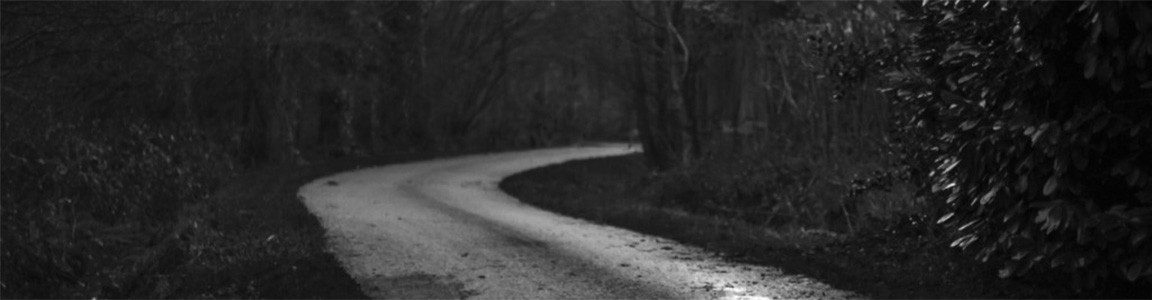
I have two postcards propped against some books on a shelf, which I look at every time I’m sitting at my desk. Their inspiration is a dark mystery or even darker suspense/thriller. I found them in San Francisco in 1989 while attending a writer’s conference. On Halloween night in 1998, I started writing a screenplay where I scared myself so much, I put it away and haven’t returned to it since. Though, I haven’t stopped thinking about it. It’s time to get it back out and finish it!

During my first marriage, when decorating parties were the trend, I bought this set of three pictures in the 70s. They remind me of the English cottages and countryside, where I think of other times. They’ve hung on my office or bedroom wall in every home I’ve lived, and I look at them every day. A time travel always comes to mind that ties into a song that came out in the 70s, too. Every time I hear the song, the plot becomes more developed. It’s time I write that story, too!

So, why aren’t I sharing these pictures with you? I will when I write the stories. I wouldn’t want to give everything away right now, would I?

***

Insecure Writers Support Group BadgePurpose: To share and encourage. Writers can express doubts and concerns without fear of appearing foolish or weak. Those who have been through the fire can offer assistance and guidance. It’s a safe haven for insecure writers of all kinds!

Posting: The first Wednesday of every month is officially Insecure Writer’s Support Group day. Post your thoughts on your own blog. Talk about your doubts and the fears you have conquered. Discuss your struggles and triumphs. Offer a word of encouragement for others who are struggling. Visit others in the group and connect with your fellow writer – aim for a dozen new people each time – and return comments. This group is all about connecting!

It All Began With a Book Report

The Insecure Writer’s Support Group

 January 8 question – What started you on your writing journey? Was it a particular book, movie, story, or series? Was it a teacher/coach/spouse/friend/parent? Did you just “know” suddenly you wanted to write?

 It All Began With a Book Report

 I often quip that I began writing because it was cheaper than seeing a psychiatrist. That statement isn’t far from the truth because that’s when I began writing in earnest due to life’s frustrations. My real start, though, occurred a decade earlier.

In a tenth grade English class when I was fifteen, I had a book report assignment. We could write about a character, the plot, or the setting. I was reading James Michener’s Hawaii at the time and was enamored with his writing, especially the many pages where he detailed the setting, the formation of the islands. I wrote about the setting in about 100 words or so. I remember getting an A- for content and a B+ for grammar. It was the A- I couldn’t believe. I reread what I wrote and was surprised at how lyrical, how detailed my words were. I wrote that?

It didn’t sound like me, and yet it was me. A me that many didn’t know about. Plus, the writing was way better than anything I’d ever written before.

Rereading my words, I remembered the sensation of being taken to another place, a magical place I now recognize as the zone. Up until that time, the zone usually occurred when I was reading. Where I could be transported into a different time, a different place, where the world would fade away.

Looking back at that time now, I find it interesting that 1) neither parent ever read that report, let alone any of my other assignments (EVER.), and 2) that no one saw my fascination with words (mostly reading at that point) where they could help me move into a career that would have suited me better, far better than the path of secretary and bookkeeper, both of which I was good at. I didn’t hate the jobs, but I didn’t love them either. The jobs were a means to an end—earnings to pay the bills. Later, though, those skills would lead me into academia, which I did love.

Through the next fifty years after high school, I would write a lot, in various genres, for various audiences, and in various media. Since my creation of Sharpened Pencils Productions LLC, I have been publishing two books a year.

I have a lot of catching up to do.

So many projects, so little time.

*****

After much pondering and consideration for her New Year’s list of 2020 projects, which includes finishing the last six of the seven Laurel Ridge novellas (covers below), Diana has chosen to finish a grammar handbook, an academic nonfiction text, and a historical screenplay based on a true event.

Insecure Writers Support Group Badge

Purpose: To share and encourage. Writers can express doubts and concerns without fear of appearing foolish or weak. Those who have been through the fire can offer assistance and guidance. It’s a safe haven for insecure writers of all kinds!

Posting: The first Wednesday of every month is officially Insecure Writer’s Support Group day. Post your thoughts on your own blog. Talk about your doubts and the fears you have conquered. Discuss your struggles and triumphs. Offer a word of encouragement for others who are struggling. Visit others in the group and connect with your fellow writer – aim for a dozen new people each time – and return comments. This group is all about connecting!

The One Trait Every Writer Needs

The One Trait Every Writer Needs

Originally posted on June 25, 2014 on my Only for the Brave blog, I offer this advice again. It’s advice that never gets old.

This trait is the one trait that finally saw me getting my first novel published. Originally, I had said if I wasn’t published with a novel by the time I turned 40, I would quit. At 40, I was so close, I couldn’t quit. At 42, I published my first book.

It’s a trait no writer should be without.

The one trait a writer can’t be without is PERSISTENCE.

The persistent writer:

    1. Submits their work.
    2. Accepts rejection. (It’s not personal).
    3. Accepts criticism.
    4. Wants criticism because they know growth occurs when mistakes are pointed out.  Plus, criticism means the writer engaged the reader, of if nothing else, hit a nerve.
    5. Pays attention to the details.
    6. Rewrites or revises, and rereads for polishing again.
    7. Resubmits.

And, repeats steps 6 & 7 repeatedly until SUCCESS (acceptance/publication) is finally achieved.

The Joy of Writing & Knowing When It’s Time to Quit

The Insecure Writer’s Support Group

December 4 question – Let’s play a game. Imagine. Role-play. How would you describe your future writer self, your life and what it looks and feels like if you were living the dream? Or if you are already there, what does it look and feel like? Tell the rest of us. What would you change or improve?

 Rather than answering these questions, I’ve chosen to write about an important topic that came up this past month.

 The Joy of Writing & Knowing When It’s Time to Quit

Throughout my writing career, I’ve seen a few writers who have said, “I’m quitting. It isn’t fun anymore. I’m not selling anything. No one is reading my stuff.” And, then, they do quit.

I’m watching a writer friend saying that they’re giving up writing. Many are rushing to the writer’s side, saying, Oh, no! Don’t quit, or This makes me so sad. It’s nice that they’re being empathic; however, I don’t think these people are listening. This writer is stating a truth, and I believe this writer actually wants someone to say it’s okay to quit or that it’s okay to take a long sabbatical.

A few are saying so but the words are wrapped in subtle positivity where the message of it’s okay to quit is buried in words of You’re talented in so many areas, and Don’t stop being creative.

Yes, there is creativity in all of us. Some are creative with yarn, others paint, others still with trash. Many are creative with food, decorating, playing a musical instrument, singing, and so forth. So many outlets for our creativity.

No one, though, can do everything well.

It can take years of trying and learning before a specific craft or art form is mastered. So, it goes: we try, quit, and try something else until we find that thing that fills us with passion.

There are some writers, though, who get lucky and find their passion and monetary success in a short amount of time. Unfortunately, those are the writers who too many of us compare ourselves to.

That said, writing is not for everyone.

Writing is hard.

Even for those of us who love to write, there are days that it makes us want to scream and cry out, Why am I doing this?

The other day someone was asking me if I’m able to write every day because I’m inspired. Not really. Somewhere along the way, an idea inspired me, but to do the actual first-draft writing, I’m usually gutting out the words. We know these words aren’t great and even somewhat stinky, fodder for the compost pile of prose as they read first written. We stick with it, though, knowing that stinky first words must occur because once shaped, they can become something wonderful—material that others want to read.

Thus, while the original writing comes first, writing is really about the rewriting. Hours and hours of rewriting.

It’s about rewriting, revising, polishing, and proofreading. And, for the self-published…promoting.

These are the parts that most people enamored with writing don’t want to do. Because it’s hard.

We writers don’t write every day because we’re inspired. We write because we put ourselves in the chair, turn on the computer, and just write—one word, one phrase, one sentence, one paragraph, one page at a time.

The joy comes once we get into the zone and where time ceases to exist, which for me can occur after a few paragraphs or a smattering of dialogue. It’s just getting those first words down that is sooooo hard.

Writing is a solitary craft.

  • Write because you have a story to tell.
  • Write because it excites you.
  • Write because you’re amazed that you wrote that.
  • Write because if you don’t, you’ll be miserable.
  • Write because you have a truth to share, characters who want their voices heard.
  • Write because you need to share.
  • Write because there’s no alternative activity or craft that provides the same joy.

Write because you simply have to.

Write because you’re willing to do the work!

A writer should never compare themselves to any other writer. Especially the monies earned, or what we think they’ve earned. Did you know that the average income for a writer is about $5,000 or less per year? AVERAGE!

It’s no mistake that so many writers teach, coach, edit for others, and work at jobs centered around writing. It allows them to earn an income that’s compatible with their passion.

Ultimately, no writer’s journey is the same as another’s.

So, to that writer who is talking about quitting, I say:

Listen to your inner voice, your gut feeling. You and you alone know why you want to quit. If writing isn’t fun, it’ll only make you angrier and more frustrated in the future.

Give yourself permission to know what’s right for you.

There is nothing wrong with saying, this path isn’t for me anymore.

If there’s no joy in what you’re doing, you’re doing the wrong thing.

Me? I’ll never quit writing. I enjoy it that much, even the repetitive, time-consuming, polishing, and proofreading parts.

******

This year, Diana published Love’s New Beginnings and Tomorrow’s Wish for Love. She’s currently writing six novellas all at the same time because they are six couples with six stories, all living in the same community, and who are in and out of each other’s stories, which included the first novella, Shattered Dreams, that is already published. She’s working toward a 2020 publication for all six novellas.

******

Insecure Writers Support Group BadgePurpose: To share and encourage. Writers can express doubts and concerns without fear of appearing foolish or weak. Those who have been through the fire can offer assistance and guidance. It’s a safe haven for insecure writers of all kinds!

Posting: The first Wednesday of every month is officially Insecure Writer’s Support Group day. Post your thoughts on your own blog. Talk about your doubts and the fears you have conquered. Discuss your struggles and triumphs. Offer a word of encouragement for others who are struggling. Visit others in the group and connect with your fellow writer – aim for a dozen new people each time – and return comments. This group is all about connecting!

http://www.insecurewriterssupportgroup.com/

How to Redeem Unredeemed Gifts on Amazon

The Insecure Writer’s Support Group

For November 6, 2019

Rather than answering the question posed to the group this month, which was What’s the strangest thing you’ve ever googled in researching a story?, for which I had no good answer, I’ve chosen to write instead about a topic I needed to google, which then I wrote my own directions so I’d remember how to find the answer in the future.

Once I had the directions written, I realized there are probably other people out there, writers and non-writers, who have gifted Amazon books and not realizing the books may still be unredeemed.

Redeeming Unredeemed Gifts:

Putting Money Back into Your Amazon Account

Have you ever gifted a book on Amazon wondering if the recipient redeemed the book? Well, wonder no more.

The first time I followed someone’s directions to find that list of unredeemed books, I was shocked to find I had $84.00 worth of unredeemed books. Thankfully, I was able to follow this person’s directions and put that money back onto my account.

Recently, I gifted a book to someone living in India. Only after the fact did I learn that with my being in the United States, such a gift is unredeemable. Now, I had to undo my gift but I couldn’t find those same directions again. Plus, it had been a while, so all the online directions weren’t current either.

Figuring my way through a hodgepodge of different directions, I was able to undo the gift, putting the money back into my account.

As to the person I was trying to gift the book to. I asked for his Kindle email address and gifted it directly to his Kindle. Hopefully, that tactic should work. If not, I’ll be undoing that gift and will be sending him a Mobi file, instead.

At any rate, here are the directions I created, producing a document that I can easily follow in the future. I share the directions with you now, wishing you a great find of hidden cash in your account.

Directions

Once you’re signed in on Amazon, click on YOUR ACCOUNT. You’ll see this screen.

click on Your Account 1

Click on YOUR DEVICES AND CONTENT as shown above.

click on your devices & content


Click on MANAGE DIGITAL CONTENT as shown above.

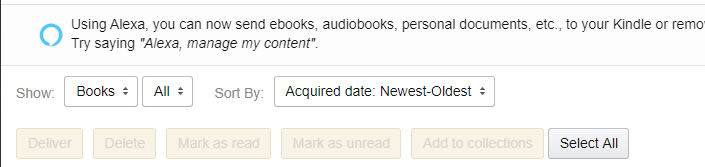
You’ll see a screen of all of your eBooks purchased and these menus at top of the list:

click on Manage Digital Content 3

Change BOOKS to GIFTS

click on Change Books to Gifts 4

You want to see GIFTS SEND: PENDING next to the GIFTS button, as seen below.

If you have any gifts that haven’t been redeemed, they’ll be listed, to which the following directions apply.

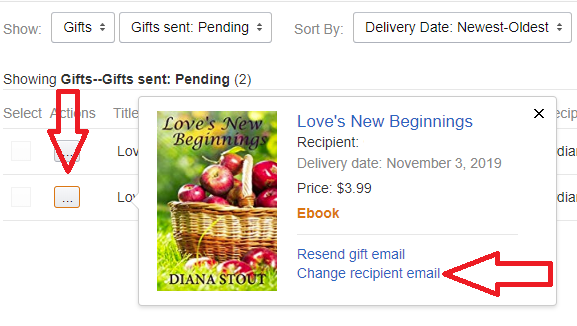
First, click on the three dots menus on the left side of the book title.

click on menu on left side 5.png

Then, click CHANGE RECIPIENT EMAIL.

(If you need to change the email address of a book gifted to a recipient, this is where you would make that change.  For instance, I’ve learned that I can send a gift directly to someone’s Kindle if they provide me their Kindle email address.)

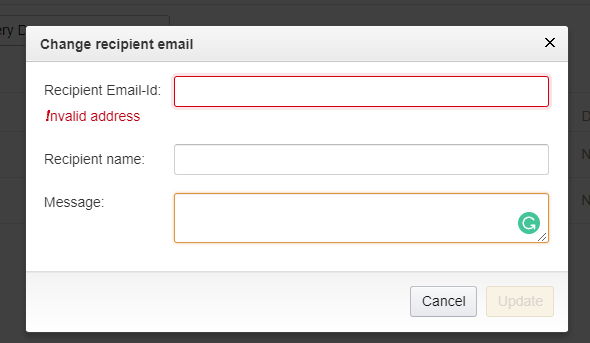
You’ll see this screen with the original recipient’s email-ID, their name, and your message if you filled them out.  Simply change the email address to your own, and click UPDATE.

click on change recipient email 6

You’ll receive an email stating you’ve received a gift Ebook.


Returning the Gift Money Back Into Your Account

Now to change that gift into Amazon credit, click on the button in the email.

click on Get Your Kindle book Gift now button 7

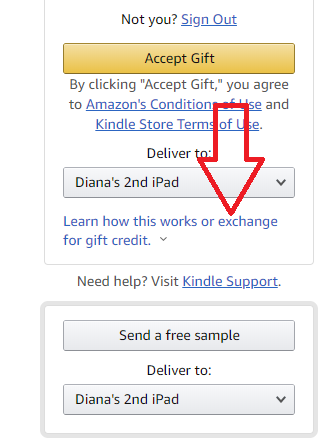
You’ll be taken to Amazon’s website where you can ACCEPT GIFT or LEARN HOW THIS WORKS OR EXCHANGE FOR GIFT CREDIT.

click on Accept Gift screen 8

This screen will open up and you want to click to REQUEST A GIFT CREDIT FROM CUSTOMER SERVICE NOW.

click on Request Gift Credit 9


Insecure Writers Support Group BadgePurpose: To share and encourage. Writers can express doubts and concerns without fear of appearing foolish or weak. Those who have been through the fire can offer assistance and guidance. It’s a safe haven for insecure writers of all kinds!

Posting: The first Wednesday of every month is officially Insecure Writer’s Support Group day. Post your thoughts on your own blog. Talk about your doubts and the fears you have conquered. Discuss your struggles and triumphs. Offer a word of encouragement for others who are struggling. Visit others in the group and connect with your fellow writer – aim for a dozen new people each time – and return comments. This group is all about connecting!

http://www.insecurewriterssupportgroup.com/

11 Reasons Why I Continue to Write

The Insecure Writer’s Support Group 

Posting for the first Wednesday of the Month, October 2, 2019

Because I’m in the final editing stages of my upcoming book, Love’s New Beginnings, which I plan on publishing in October, I thought I’d share some encouraging thoughts and moments I’ve experienced in my forty years as a writer.

11 Reasons Why I Continue to Write

Newly Published - July 2019

  1. Opening a box of newly published books never gets old. Never.
  1. If I don’t write, I get grumpy.
  1. I like to believe that one day I will be a best-seller author and have my story portrayed on the screen. At this point, I’m not fussy; while I had preferred the big screen, the little screen will do just fine.
  1. I get to hang out with other writers! And, they are the best people ever. They know how to spell! They laugh a lot. They know how to add to my idea, thus making it a great idea. They’re just as geeky about grammar as I am! They get me.
  1. I’ve become an expert in something: plotting, developing characters, writing, punctuations and grammar, writing loglines.
  1. I get to have geeky conversations on Facebook, such as whether the Oxford comma is needed or not. And, the conversations create more posts from one question asked than any political conversations elsewhere.
  1. Books and movies—old and new—get recommended.
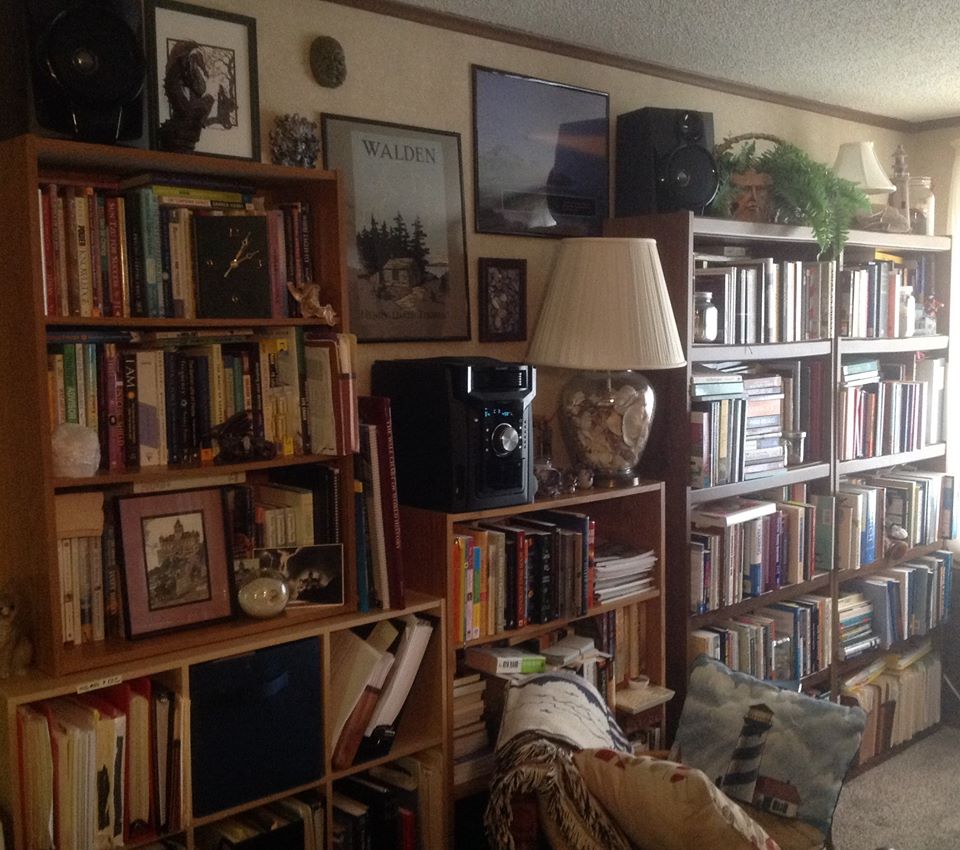
  1. Diana's wall of booksIt’s okay that I have a lot of books. Lots.
  1. When writing, I enjoy losing track of time.
  1. It’s the only way I can get the voices out of my head.

Oh, and Reason #11 – Do I really need a reason when it’s pure fun?

Why do you write?

Insecure Writers Support Group BadgePurpose: To share and encourage. Writers can express doubts and concerns without fear of appearing foolish or weak. Those who have been through the fire can offer assistance and guidance. It’s a safe haven for insecure writers of all kinds!

Posting: The first Wednesday of every month is officially Insecure Writer’s Support Group day. Post your thoughts on your own blog. Talk about your doubts and the fears you have conquered. Discuss your struggles and triumphs. Offer a word of encouragement for others who are struggling. Visit others in the group and connect with your fellow writer – aim for a dozen new people each time – and return comments. This group is all about connecting!

http://www.insecurewriterssupportgroup.com/

Should’a…Could’a…Would’a…

Today, I have a guest blogger.

Keri Kruspe, fellow writer and friend, writes this blog and shares with you her experiences as a first-time author and what she wished she had known beforehand. I wish I had known, too.

SHOULD’A…COULD’A…WOULD’A… 

What I wished I’d done differently

By Keri Kruspe

Now that I’ve gotten more than six months of being an indie author under my belt, I wanted to take a step back to see what (if anything) I would have done differently to start my publishing career.Keri Kruspe - what should I do list png

The short answer is yes…yes, I would do a couple of things differently if I could do it all over again. In order to give a clear reason as to why I say that, let’s take a look at where I was back in October of 2018 when I launched my first novel.

Back then, I had to start everything from scratch–

  • Website (you mean I need my own…?)
  • Media Presence (i.e. Facebook/Twitter/Pinterest – which ones – how do I use them?)
  • Author email
  • Author Brand (Brand…what in the world…)
  • Decide to go “wide” or “KU” (huh?)
  • What software to use to format for electronic readers as well as paperback (never heard of epub…mobi…again huh?)
  • Newsletter or blog
    • Create your newsletter subscribers (where in world would they come from?)
  • How do I find an editor who will work with me? What about a proofreader – do I need both or more?
  • Where do I find a good cover artist for my genre (heh…I read/write in a genre?)

More importantly – where in the world do I go to learn how to do all of this??

Instead of diving deep into each one, I thought I’d give an overview of what I strongly feel I’d like to do different if I could go back into time and have a do-over.

WIDE OR KU?

Ah, the ago-old question. In all of the training I’ve taken, the overwhelming answer you get is, “it’s up to you…it’s a personal decision.” A very nice, safe, gentle non-answer that doesn’t help much.

So, here’s my two cents worth: If I only had one book to release starting out – I’d do KU first.

Let me explain.

When I started as a new author, I had A LOT to learn (see above). I figured, no big deal, why not go wide and reach not only Amazon customers, but everyone else in the universe as well. Why get stuck for 90 days in only one vendor – I planned to release the other books right after the first.

Well, things didn’t work out quite that way. Because of my inexperience, I didn’t realize how much time it took to get each novel ready (and I’m talking about after I’ve written it and done my own “due diligence” in editing it on my own).

Because I had so much to learn and do – if I’d gone with Amazon exclusive with the first one, I would have gotten a little “boost” in launching my book – plus have a little extra “time” to learn the ropes while I got the other books ready. I could have stayed there for 90 days, and by then at least my second book would be ready and I might have gone wide then if I wanted to.

READER MAGNET  Keri Kruspe - reader magnet

In all the “noise” of trying to get advice on what makes a successful author (by noise I mean, training, websites, various advice on social media) the one that stands out the most is you have to have a healthy mailing list (okay, had to admit I didn’t know what a mailing list/reader magnet was until after I launched by first book). And in order to get that list, you need to over a “reader magnet.” Which, loosely defined is a prize your readers gets when they join your mailing list.

There were several suggestions on what to offer for a reader magnet: a book in a series (ack – only had one book…so this was a “no go”) or a short story or even something exclusive to what I was writing. So, I used my “writers bible”, something I created about the universe of my trilogy. It was a thirty-page “encyclopedia” with various info of my characters and the aliens (the trilogy is a sci-fi romance). Should work…right?

Wrong.

Seven months after my launch, I only have 40 subscribers on my list. If I could have this “do-over” I’d have a short story reader magnet ready to go before I launched my book. Because I thought my little catalog would be a good incentive, I waited until three months into my publishing career to rethink the whole thing.

So, taking a deep breath, I pulled out an old short story (around 35,000 words) I wrote ten years ago and gave it a complete overhaul. I’m hoping to release it in July and then start a mailing list campaign (fingers crossed). My goal is reaching at least 100 subscribers by the end of the year.

Wish me luck.

VARIOUS STUFF

Keri Kruspe - cluttered desk pngIn hindsight (don’t you love hindsight?…it’s always so spot on…), I wouldn’t have tried to learn everything at once. It’s so hard to figure out how to make a website from scratch while learning the ins-and-outs on how to create/maintain several social media business accounts. Add to that how to effectively create visual ads (Canva and BookBrush are my friends). Also, how do you make those ads profitable? What makes them profitable?

Let’s not mention that at the same time I had to learn how to polish my writing skills (this includes eliminating my unnecessary adverbs/filler words and creating an in-depth point of view for my characters).

What I should have done was finish learning my writing craft first. This may or may not include working with an editor. Then I would have mastered these skills one at a time (instead of trying to do them all at once) and I would do it in this order:

  • Hire a reputable cover artist
  • Find appropriate editors
  • Design and create my website
  • Sign up for an EMS (email mailing service) and produce a landing page with my reader magnet ready to go.
  • Learn how to upload/format my books (including paperback)
  • Discover how to upload formatted book onto the appropriate retailers (i.e. Amazon, Barns & Nobel, etc)
  • Marketing – this could include making ads (and how to determine if they’re viable). How to join/create a blog tour, and/or newsletter swaps. Let’s not forget social media. Learn when and how to use them.

WRAP UP  Keri Kruspe - Resuts Excuses

Okay..whew..got my frustrations out. Now that I’ve finished venting, what’s next?

Now it’s catch-up time. My trilogy is out in the world and it’s time to create a new story. I’m getting back into the habit of reaching my writing goal every day. As I mentioned before, I want to finish working on my reader magnet and start the campaign to increase my subscription list. Still trying to master making ads and monitoring them. I’m sure I’ll be working on that for the rest of my career.

As for the “should’a” part of this article, well, wallowing in regrets isn’t quite my style. I’d rather learn from my “mistakes” and move on. If my experience helps others, that makes me happy. Please keep in mind this disclaimer…what I’ve written is only my opinion. There’s no guarantee what I think should have worked better actually would. You know what they say about opinions…everyone has one!

*****

Keri Kruspe PicKeri Kruspe, author of Otherworldly Romantic Adventures – writing about feisty heroines who aren’t afraid to take chances in life or love.
Keri has been an author since the age of twelve and has always been fascinated with otherworldly stories that end in Happily Ever After. Her current sci-fi romance trilogy, An Alien Exchange (winner 2018 SPF Galaxy award) had its first release winter 2018. The story continues with D’zia’s Dilemma and concludes with Ki’s Redemption.

A native Nevadan, Keri resides with her family in the wilds of Northwest Michigan where she enjoys the stark change in seasons and the pleasures each one brings. An avid reader, Keri loves an enjoyable bottle of red wine, a variety of delicious foods and watching action/adventure movies…usually at the same time. You can find her most days immersed in her fantasy world on her latest novel while foot tappin’ to classic rock. When not absorbed in her writing, Keri works alongside her husband in building their dream home or discovering intelligent life in America in their RV. Join the fun and sign up for her mailing list at www.kerikruspe.com


Failures – Part III

To continue my “Failures” series, this post was originally published on my Only for the Brave blog on January 9, 2018.  And now, I’ve added more thoughts.

Failure According to Sue Grafton

As I considered my next blog in this series, I came across this article in my mailbox and thought I would inject a small part of it here, between my writings, because Sue Grafton confirms what I wrote about in “Failures Part II,” in that we learn by failing.

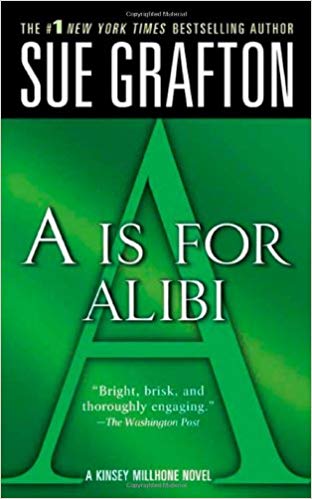
Sue is the best-selling and award-winning author of the famous alphabet murder mystery series, with Kinsey Millhone as the protagonist: A is for Alibi, B is for Burglar, C is for Corpse…

Here are Sue’s own words about what constitutes success and why failing is important. The source link for her quoted words is below.

What has made you so successful?

I hope it is because I try to be honest, and I try not to sell anything. I just try to let the work take care of itself….

What advice do you have for newer writers?

My big gripe about newer writers is they’re not willing to put the time in. Somebody’ll write one book and they’re asking me who my agent and my editor are, and I’m thinking, Don’t you worry, sweetheart, you’re not any good yet. Give yourself time to get better. Writing is really hard to master. You learn by failing over and over, but a lot of people don’t care for that, thanks. I always wish new writers the greatest good fortune. It’s a helluva journey—I’ll tell you that.

“You learn by failing over and over.”  She’s also confirming that if we write a good story, the writing will sell itself.

Reading her words, I’m being reminded once again, and again by an expert writer, that I need not focus on the selling but that I need to focus on the writing.

No amount of advertising can sell a mediocre book. However, a great story will sell itself because readers can’t help but tell others how great it is. There’s no advertising like word-of-mouth advertising. Recommendations are priceless.

—

Guest Column. “W Is for Writer: A 2010 interview with Sue Crafton (1940=2017).” Web blog post. There are No Rules. Writer’s Digest, 31 Dec. 2017. Web. 9 Jan 2018.

http://www.writersdigest.com/editor-blogs/there-are-no-rules/interviews/w-writer-2010-interview-sue-grafton-writers-digest

The Surprising Secret of Developing Characters

The Insecure Writer’s Support Group

 The question this month is:  Has your writing ever taken you by surprise? For example, a positive and belated response to a submission you’d forgotten about or an ending you never saw coming?

 The Surprising Secret of Developing Characters

I’m such a plotter one would think that I’m never surprised. The truth is that with every story I’m always surprised. The words that come out of my characters’ mouths are smart, engaging, and laugh out loud funny. So much so, I’m usually laughing aloud while writing, with my laughter surprising those around me whether other writers at a write-in or strangers in a coffee shop.

Often, I find my characters’ banter doesn’t require tags because the characters each have a distinctive voice, so it’s easy to know who is talking. The advantage is because we know who is speaking tags aren’t required. Thus, the writing becomes action and dialogue, with some narrative now and then rather than all the time. Even then, I try to keep the narrative down to a minimum.

Once I know the bare-bones outline of a story—how it begins and how it ends—I spend a lot of time finding out who my characters are. Many writers will interview their characters wanting to know about their background: where they went to school, what’s their favorite color, favorite music, favorite TV program, and so forth.

To me, while I want to know my character’s physicalities—such as hair and eye color, height, their job, their tangible goal—it’s more important for me to know their pain, their wound(s), the deep dark secret they don’t want anyone knowing.

To discover this information, I become the character. I do so by writing character journals. I start out saying my (their) name, where they’re from, and so forth. These various details will take up half a page and then, suddenly, I (the character) will say something that begs a question of what do you mean by that, or what happened, or how did that make you feel? That’s when the character goes deep. By now, I’m talking (writing) in that character’s voice. My voice and my thoughts are no longer my own, but theirs. I’m seeing through their eyes, feeling their pain. And, the writing becomes a stream of consciousness in their desire to reveal everything that hurts. Everything that up until this moment, has remained a secret that they can’t live with anymore.

By the time they’ve run out words, I’m holding three-to-five single-spaced typed pages. I have their goals, their essence, their true character—not the one that others in the book get to see and have seen forever, but the one they struggle to overcome.

It’s that pain that drives the character, which in turn drives their response in word and deed, which then drives the plot forward. It’s these elements that then help me plot out the middle, the important emotional points that spin the story into different directions.

It’s that pain that becomes the character arc, the thing that the character must overcome in order to win the girl, get the job, get the prize, and to finally obtain self-respect. It’s the thing the character will no longer have to face in their future.

It’s character pain that attracts readers. They want to see how a character will resolve their wound because that wound could be their own.

It’s character pain that engages readers, that makes them turn the pages. The suffering, the action, the pain.

It’s the pain overcome that provides a satisfying end to any story regardless of how the story ends: happily ever after or bittersweet.

The secret of developing characters is much like an iceberg. It’s not about the ice we see above the surface, the ice a character has shown us up until now; it’s about the ice we don’t see, the ice below the surface, the ice we get to learn about. How deep that ice goes, how big of a problem the ice really is.

So, when it comes to developing characters, the secret I share with you is this: Go Deep.


Insecure Writers Support Group BadgePurpose: To share and encourage. Writers can express doubts and concerns without fear of appearing foolish or weak. Those who have been through the fire can offer assistance and guidance. It’s a safe haven for insecure writers of all kinds!

Posting: The first Wednesday of every month is officially Insecure Writer’s Support Group day. Post your thoughts on your own blog. Talk about your doubts and the fears you have conquered. Discuss your struggles and triumphs. Offer a word of encouragement for others who are struggling. Visit others in the group and connect with your fellow writer – aim for a dozen new people each time – and return comments. This group is all about connecting!