In today’s Writers in the Storm blog, Joseph Lallo talks about “Restarting Old Projects / Continuing a Series After a Hiatus,” saying, “Chances are good that any author who’s been at it long enough will have at least one project that’s been simmering for years, either in an unfinished state or begging for a follow-up.”
I wish I had only one project that’s been simmering for years. Instead, I have dozens! Extremely prolific in the ‘90s, most projects were drafted and not polished. Those that were finished weren’t finding a home, as this was well before indie publishing, when one needed an agent—a difficult task to achieve.
Fortunately, I managed to get published with two different publishers, and having made lots of cold calls to Hollywood producers, I was working with half a dozen who wanted to see everything and anything I did. But then in 1998, a divorce, a move across the country, and then returning to school as a non-traditional student, my creative writing got put on hold for fifteen years.
Oh, I was writing. More academic than creative, but I did manage to write papers with topics I could later use for more projects. Silly me. Adding to the pile of unfinished ideas.
I’d been teaching professionally for a decade, and it was two years after receiving my Ph.D. that I was let go from my job—two years before I could officially retire with full benefits. Two years later, I officially retired, and within months, I created my production company and became an indie publisher. The first book was Grendel’s Mother, an idea generated after studying Beowulf in three different classes and realizing Grendel’s mother had no voice. My book gave her one.
After that, I began pulling projects off the shelf, blowing off the dust, and giving them life.
It’s been quite the journey.
Looking at my list of books published, they all have ties to earlier projects I’d written or had been teaching since the ‘90s, except for last year’s publication, Harbor House: Deadly Intentions. That story was a new historical Gothic novella for an anthology, published in 2024, which I then tied into a newly written contemporary story, allowing me to create a split-time thriller.
The current thriller I’m working on, Buried Trash: A Shelby Hale Thriller, is a mystery series resurrection from the ‘90s that I’m turning into a thriller. It’s the characters who hooked and convinced me to make the conversion.
From that 1996 manuscript, let me introduce you to the main character…
I’m Shelby Shawn Sherman Roberts, one month shy of turning thirty-nine. I hate gossips and love cotton candy. I’m slim, with shoulder-length dark hair and brown eyes. I squint too much (need glasses), drive too fast, and laugh too loud.
My first name belonged to my grandfather, and my mother protested it being hung on me, but Dad told her, “It’ll make her strong.” The only thing it did for me was get me a bloody nose or a black eye every first week of school until I entered fifth grade and I was finally able to return the favor. I guess Dad was right, after all.
Mom named me Shawn after her first actual boyfriend. The one that made her toes tingle when he kissed her, she said. In her mind that was what love was all about. Of course, Stuart, my ex-to-be, never did make my toes tingle. I thought he did once, but then I realized he was standing on my foot.
I’m constantly asked—or rather used to being asked when I was single—if I was related to that Sherman. I guess my Southern accent lends one to think I don’t mind hearing that question. It was usually asked by some drunk fraternity boy who always had a leer on his face. You’d have thought I’d have learned my lesson and stopped going to those kinds of parties. What can I say? I was young. I was more stupid then.
Come to think of it, I met Stuart at one of those parties.
While she starts out as Shelby Shawn Sherman Roberts, she changes her last name to Hale. A name she creates for herself now that she’s creating a new life and moving back to her small hometown and a pecan orchard she inherited some time ago. Her plan is to live in the trailer her ex installed on the property when she first inherited it.
And then, her first morning back from Atlanta—after the court appearance to finalize the divorce and collect the rest of her belongings—she finds a body in her trash can.
From the current rewrite, the book begins:
Had I known ahead of time that what I’d find in my trash can would put my life in danger, I would have done the smart thing: say nothing, not call the sheriff—my best friend and my first husband for all of about a month when we were 19—and let the garbage truck pick up the trash, as usual, letting the truck empty its contents into the country landfill.
Unfortunately, I’m not known for doing the smart thing. I react, not thinking things through well enough.
It’s how I ended up married three times.
I’m 38 and starting over.
Again.
The potential for this book to become a series is there, but it’ll depend on the readers. Hopefully, it’ll garner enough fans who want to read more.
Be sure to follow me here, and then go subscribe to my What’s New with Dr. Diana? announcement-only newsletter/blog on my website, so you can follow my progress via email. I plan to publish Buried Trash in the fall or late summer. With over 25k words already written and the story plot revised, my goal is to finish the first draft this month.

The Secret Joy of Writing & When Lightning Strikes
Every business has practices that participants try to follow, believing they are best practices.
Writing is no exception. Large numbers of blogs and books are written on how to launch a book. And, each includes a long checklist that starts months before publication. After publication, there’s more promoting: newsletters, more blogs, book signings, blog tours, social media participation, ads, and more.
Not to mention, joining writing organizations, attending conferences, subscribing to newsletters, and taking classes.
Truthfully, the list of things a writer should do, whether indie or traditionally published, is overwhelming.
Most writers say their joy comes from the writing. I don’t know of a writer, yet, who says they love promoting their books.
I’m no exception. My joy comes from writing, teaching, and helping other writers.
After much analysis of how I spent my time in 2023 (60% promoting, 30% writing, 10% everything else), I realized that to flip those numbers, I needed to make drastic changes. I began asking questions like, Do I really want to do this? Do I need to do it?
I concluded that…
I’ll do book signings when readers clamor for them.
I have a newsletter, but it’s an announcement-only newsletter, which means I send them out only a few times a year. Producing a regular newsletter doesn’t work for me.
I’m on social media, but I don’t like doing videos or podcasts. So, I’m highly active on only a few platforms.
I still have big goals, but better yet, I have great writing habits that move me toward achieving them.
As a result of my changes, in 2024, I spent 80% of my time writing and 10% promoting. Because I believe a backlist is important, I wanted to produce more.
Finally, I stopped comparing my activities to other writers. I allowed myself to be different, to do me. Now, I only compare myself to how I’m doing this year compared to last year.
And when I read a book from an unknown (to me) author, I took comfort in later discovering her method was even more extreme than mine.
—
The Tale of One Author Who Did It Her Way and Still Does
After I read one book by this author, a book she’d published after about 15 other books, I learned she had written about 24 books total, so far. I found her 30,000 members strong fan group of mostly readers and some writers and joined.
I began reading her earlier books. While they weren’t as riveting as the first one I read, as I moved through her backlist, I could see how her writing improved.
Her print and eBooks were sold only through Amazon. She was an indie author who did no book signings, no interviews, no publicity, and minimum advertising on Amazon.
Suddenly, her fan base blew up and her books started hitting the best-seller lists. At one time, she had three books in the top ten. Publishers began seeking her out, republishing her books.
Now, her fan group has 170,000 members. She has two publishers with print books everywhere and audiobooks online in libraries. She continues to be in the top ten of the best-selling lists, and she still participates in her Facebook group where she started. She’s vowed her eBooks will always remain in Kindle Unlimited. Today, she has an agent, and her most popular book is being made into a movie.
While she doesn’t do book signings, she does sign books that are sold through the bookstores, plus she sells bookplates that are signed. They’re just one product on her website, products readers requested,
Lightning struck because she authored great stories readers wanted to read. She wrote for pure enjoyment, then started publishing them just to share. She wasn’t interested in making money; she already had a career—as a doctor.
She did her.
She’s my role model.
Her name is Freida McFadden.
While I’d love to be earning a living from my writing and don’t have a secondary career anymore, I’m doing me and trying to manifest my own lightning strike. Thus, my focus is to author great stories and to share what I’ve learned. Hopefully, one day, I’ll have a rabid fan base, as well.
In the meantime, I’m excited every time I open a box of newly published books and find immense joy in the writing.
—
Your takeaway: Take time to try different activities, but stick to those activities that are a good fit energy- and money-wise for you. Activities that leave you feeling joyful and excited to be a writer.

Let No One Destroy the Dream Maker
Martin Luther King, Jr. said, “No person has the right to rain on your dreams.”
I had a best friend who claimed to be a romance writer, though she never finished a story that I knew of, never submitted anything, and spent more time quilting than she did writing. She liked to talk about writing, though, and she was great at brainstorming.
When I became interested in screenwriting, she did, too. She liked coming up with ideas. Then, I began working with half a dozen different producers who liked my voice, liked my writing. They wanted to see anything and everything I wrote. It became a matter of finding the property that would be a good fit for them.
When I optioned a screenplay with a Canadian producer who had ties to Hollywood, she told me it wouldn’t go anywhere. She stated that I’d never sell a script because I didn’t live in Hollywood, wasn’t young enough, and wasn’t the right sex.
I was in my 40s!
I asked her why she would stomp on someone’s dreams like that?
Crickets.
Later, I discovered her mother had stomped on her dreams of being a clothing designer. So, she became an office assistant for NASA, a job her mother approved of but which my friend hated. She retired as soon as she possibly could. Quilting, a part-time hobby for much of her life, now became her full-time hobby, along with the care of her many cats.
While that optioned screenplay ended up not going anywhere—which is true for many optioned screenplays—just getting it optioned was an enormous step in the multi-step process of a script being filmed.
I still have hope for that script. Why?
Because it performed decently in contests and still garners excitement when I’m asked what is it about and I provide its logline pitch. Currently, it’s a project that needs a facelift.
And now, after a 30-year hiatus from screenwriting—due to a divorce, a return to school, and a career of academic teaching, during which I was writing Grendel’s Mother, retired, and became an indie publisher of 20 books, I’m finally back.
In coming back, I’ve rejoined Scriptwriter’s Network, a screenwriting organization I belonged to decades ago, during which I judged their screenwriting contests for a decade.
As a result of coming back, I’ve been invited to do a webinar on October 19, with the Network’s president who is hosting the event. I was thrilled to be asked and am honored to present and hopefully help other writers.
I feel like I’ve come home.
Back when my best friend stomped on my dream, I knew her stomp wasn’t about me. It was all about her. She wanted me to live the same script she was forced to live. The adage of misery likes company was the subconscious core of her words.
She wasn’t the only one who tried to talk me out of my creative writing or going back to school. They all said the same thing: that I was wasting my time, wasting my money. There were others, but her voice was the loudest and most consistent.
I ignored the advice and continued onward, listening instead to the little voice that had cheered me on, whispering that it was okay to follow my passion. I knew from experience that my little voice was never wrong.
My dreams were about publishing books, being able to help other writers, presenting, becoming an acclaimed screenwriter and best-selling author. So far, I’ve achieved most of my goals. The big monster goals are still goals to achieve, but I continue to work and strive toward them. Always listening to that little voice from within.
When my stepfather was nearing the end of his life, we had a great many talks about life, and I asked him if he’d had any regrets. Immediately, he replied with a sad, resigned expression, “I wish I had lived my own life, making my own decisions.”
Don’t let others stomp on your dreams. Age doesn’t matter. Follow your passion, and if that passion doesn’t pay the bills, take whatever day job(s) that will pay your bills, while you pursue your passion at the same time. Having other responsibilities can slow you down, as it did me from time to time, but the key is to never give it up.
It’s never too late to start. The joy you receive is beyond words. You’ll never regret the pursuit.
I sure don’t regret the unusual path I took. While it hasn’t always been easy or always fun, it’s been interesting and lesson filled. And, I’ve met a lot of incredible people along the way. Every success, no matter how small, has been a win.
Currently, I’m writing a psychological paranormal thriller novel and plan to publish it by the end of the year; plus, I plan to write it as a screenplay, too. Other screenplays will follow, along with a continuation of my Finding Your Fire series.
What about you? Are you living the life you always desired? Are you ready to start living that life now, even if only for fifteen minutes a day?

Author Envy?
The Insecure Writer’s Support Group
This month’s question for March 1 is: Have you ever read a line in a novel or a clever plot twist that caused you to have author envy?
Author Envy?
I read sentences and phrases in books all the time that stop me in my tracks, where I’ll reread the sentence several times, soaking up its art and beauty, its construction and perfection. But, envy? No. Never. Admiration? Always!
An unforgettable read in January comes from Verity by Colleen Hoover. She’s describing the house and ends the paragraph, page 44 with:
Ivy covers the left side of the house, but instead of charming, it’s threatening—like a slow-moving cancer.
And then, the end of the next paragraph, same page:
My mother used to say that houses have a soul, and if that is true, the soul of Verity Crawford’s house is as dark as they come.
I was hooked by the promised creepiness of a dark ride into the terror of Gothic fiction.
My intent when writing is that I, too, can create that kind of artistic beauty for my readers, catching them unaware, anticipating the journey before them.
Currently, I’m finishing the last two novellas in my romance series of Lauren Ridge and am working on a nonfiction book that will help writers, but at the same time, I’m also plotting out a new Nicholas Sparks-like romance and two different Gothic suspense stories. I’m excited to be writing all of these stories.
That said, it’s time for me to return to my word for the year: FOCUS! Get that writing done!

Purpose of The Insecure Writer’s Group: To share and encourage. Writers can express doubts and concerns without fear of appearing foolish or weak. Those who have been through the fire can offer assistance and guidance. It’s a safe haven for insecure writers of all kinds.
Posting: The first Wednesday of every month is officially Insecure Writer’s Support Group Day. Post your thoughts on your own blog. Talk about your doubts and the fears you have conquered. Discuss your struggles and triumphs. Offer a word of encouragement for others who are struggling. Visit others in the group and connect with your fellow writer – aim for a dozen new people each time – and return comments. This group is all about connecting.

October’s Glory
The Insecure Writer’s Support Group
The question for this month is: What do you consider the best characteristics of your favorite genre?
Because I have a number of favorite genres, that question becomes long in answering. Instead, I’m choosing to write about my favorite month of the year: October.
October’s Glory
As much as I had to see summer end because it means having to shut the windows and doors and blocking the sounds of nature—mostly the birds—I am absolutely thrilled when October arrives. Here are the many reasons why I love it so.
My favorite season, fall, is finally here!
The vibrant and picture-worth colors start arriving. Reds, orange, yellow, lots of various greens and browns, where the trees become a fashion parade of brilliance. Breathtaking around every corner and at every glance. If only those colors could last longer than just a couple weeks.
The air becomes crisp, requiring a light jacket in the morning and evenings. If the temps do warm up a bit, there’s a cool undertone just waiting for the warmer temp to slip up so that it can sneak in again.
The food – Candy corn! Pumpkin pie, the bounty of vegetables from the garden, casseroles, soups, chili!
Cuddling up under a blanket.
SWEATERS! Need I say more?
And, it’s my birthday month. What better way than to celebrate my favorite month, my favorite season, right?
How about you? Do you enjoy October?
*****

Purpose: To share and encourage. Writers can express doubts and concerns without fear of appearing foolish or weak. Those who have been through the fire can offer assistance and guidance. It’s a safe haven for insecure writers of all kinds.
Posting: The first Wednesday of every month is officially Insecure Writer’s Support Group day. Post your thoughts on your own blog. Talk about your doubts and the fears you have conquered. Discuss your struggles and triumphs. Offer a word of encouragement for others who are struggling. Visit others in the group and connect with your fellow writer – aim for a dozen new people each time – and return comments. This group is all about connecting.
How to Become a Writing Maverick: aka, a task-oriented and persistent writer
The Insecure Writer’s Support Group
The questions for this month are: When the going gets tough writing the story, how do you keep yourself writing to the end? If [you] have not started the writing yet, why do you think that is, and what do you think could help you find your groove and start?
How to Become a Writing Maverick: aka, a task-oriented and persistent writer
What do I use to help me find my groove when starting to write?
- I’ll listen to genre mood music, usually soundtracks from favorite movies; or, I’ll listen to sounds of nature.
- I’ll just start writing, knowing the first couple page equates to priming the writing pump so that the well of words will flow easily. These first few pages will probably be garbage and that’s okay.
If I haven’t started the writing yet, why do I think that is?
- I’m procrastinating. Climbing any new mountain looks daunting. I’ll find a writing task to do instead.
- I’m exhausted from finishing the last project. I’ve learned I need a short break between major projects. That’s when I’ll file papers, clean off my desk, and perform other types of writing tasks.
When the going gets tough writing the story, how do I keep myself writing to the end?
- I gut it out. I put my butt in the seat and make myself write the words.
- I write every day. Even if it’s only for five or ten minutes. If that’s all I can accomplish that day, it’s enough.
- I write first drafts now by ignoring the mistakes, the rules, and the inconsistencies because this is where I can get taken down by trying to rewrite before the first draft is finished.
- It happened with Grendel’s Mother, which was a 10-year process, with a 7-year gap between starting the first draft and its completion. The first three years, I spent rewriting the first 40 pages multiple times.
- It happened with my Laurel Ridge Novella series, where the first book, Shattered Dreams (#1), was published, and now five years later where I’ve just published Burning Desire (#2), and have Arrested Pleasure (#3) set up as a pre-order. I discovered I had to write all of the following six books as first drafts before I could publish #2. The other four books of the series will be published closely behind #3.
Every day is about priming that pump, finding that zone.
If I can’t find the zone, I just write anyway. I know from experience that without any words placed on the page, I’ve got nothing to work with later.
Some days it’s easy, other days it’s not. But the end result, the opening of that box of new books, is always the same. Pure ecstasy.
Purpose: To share and encourage. Writers can express doubts and concerns without fear of appearing foolish or weak. Those who have been through the fire can offer assistance and guidance. It’s a safe haven for insecure writers of all kinds.
Posting: The first Wednesday of every month is officially Insecure Writer’s Support Group day. Post your thoughts on your own blog. Talk about your doubts and the fears you have conquered. Discuss your struggles and triumphs. Offer a word of encouragement for others who are struggling. Visit others in the group and connect with your fellow writer – aim for a dozen new people each time – and return comments. This group is all about connecting.

Pssst – Wanna Learn the Secret to Writing Every Day?
I’m in a lot of online writer forums where I see the same repeated question coming from new writers. How do I find the motivation to write every day?
My answer is: Use Jerry Seinfeld’s “productivity secret,” where his goal was to write jokes every day, thus allowing him to mark that day on the calendar with a big Red X.
I started using his secret method on January 1, 2013, the semester I began writing my dissertation from the extensive outline I had created the semester before.
By early February 2013, I saw a pattern emerging. Red Xs from Thursday through Monday, but nothing on Tuesday and Wednesday. During that winter semester, I was teaching five classes total: two afternoon and one evening on Tuesday, one on Wednesday afternoon, and the last on Thursday afternoon. I’d celebrate getting through another week’s worth of teaching by going home and writing that night.
When my sister died in mid-February, there were fewer Red Xs for a couple weeks, even though from the other side, she encouraged me to keep writing. By the end of February, I realized if I was going to keep my April dissertation defense date, I had to step it up. Yet, that earlier pattern persisted. As that defense date drew closer, I knew I had to make a serious adjustment to my writing schedule.
I kicked the writing into high gear. Despite my full teaching load of five classes and performing only the minimum of household duties once home, I’d write until midnight or one a.m. every night. I remember having carried a grocery list for six weeks before I finally made it to the store. Thankfully, I had a well-stocked pantry and made do with what I had. My other saving grace was that I lived alone and had no pets.
My daily routine was to sleep, teach, and write, putting off anything and everything else that I could. Socialization and time spent online came to a screeching halt. I went through a lot of drive-throughs during that time and would pick up cereal and milk at the gas station.
When I look back at the calendar of March and April that year, I see that Seinfeld’s trick worked. From mid-March onward, the calendar became a continuous red serpentine of big, bright Xs.

I defended my dissertation on time and graduated that summer on schedule.
As I continued teaching full-time, a pattern would emerge, then change as each semester’s schedule changed with short interruptions of illness, my mother dying in 2014, and my being involved in a 22-car pileup later that year. And then, at the end of 2015, I retired.
I started my production company in March 2016 and have been writing and publishing ever since. The Red Xs weren’t continuous in the beginning. There were as many days without those Red Xs as there were days with them. But, in the last few years, the Red Xs far outnumber the few non-writing days.
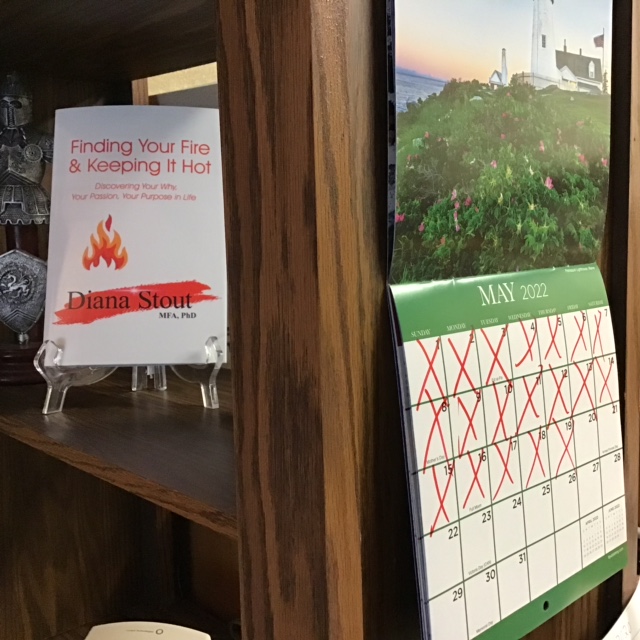
It’s a rare month that has all the days marked. Everyone needs a day off now and then, but it makes me happy to see the majority of days with Red Xs.
Those Red Xs back in 2013 were a source of motivation to keep me going each day while I worked full time and still am even in retirement. But also, those Red Xs are a source of pride, showing that it is possible to do what I had always dreamed of—writing full-time. A topic I wrote about in a recent release: Finding Your Fire & Keeping It Hot. How to find that motivation you desire.
An introduction
Asked to write an introduction to a Facebook writer’s group recently, Not wanting to write the usual intro composed of achievement, instead, I wrote…
She steps out from the center of the crowd, several dozen individuals all clamoring for individual attention. She’s listening, waiting for that one voice to stand out. Those standing closest to her, whisper. She nods, acknowledging. They are the once-was, having passed through that thin veil of death. Some guide, some want messages passed on to those still alive. Some are waiting (for her), others are hoping to get another chance (will they return to reunite?). The others–the shouters–clamor that their story be told. It’s their turn. She listens for that one voice that will provide that missing element that will raise their story above all others, providing her with that hook, that aha element that connects the character/story tissues.
She is Diana. The eclectic mystic, intuitive, observant, learner. The writer who follows her goosebumps, knowing they are the true path toward that shiny golden Oscar. The deciders had loved her voice but the projects presented weren’t quite the fit they sought. “But, send us everything you write,” they instructed.
So close.
Then, as life does, interference jungled that path and took her to the land of depth and breadth. She emerged the wiser, with creds and authority. And now, she has returned to the land of creation, embracing the cacophony of voices all clamoring for individual attention as she chooses the next story, the unfolding adventure that mysteriously and magickly arises from the synapses mist and fog, listening to those who have gone before and point the way.
To learn more about Diana’s portfolio, awards, presentations, blogs, and more, visit her website, the center of the wheel from which all paths, like spokes of the wheel, extend.
www.sharpenedpencilsproductions.com

The Secret Mystery Behind Deep POV
The Secret Mystery Behind Deep POV
There have been a lot of discussion lately about Deep POV with different blogs and articles asking:
- What is Deep POV?
- Why should I care?
- Why should I learn it?
- What does it look like?
While Deep POV may appear like a new topic, it’s actually been around for a long, long time. You know the adage of what goes around comes around, right? Some say Deep POV appeared 20 years ago, others say 40; in any regard, Deep POV has come around again.
Aristotle’s three-act structure—four equal acts as the second act is two parts—was recycled into a template by Syd Fields for screenwriters.
Joseph Campbell’s hero’s journey was recycled into a writer-friendly how-to/reference book by Christopher Vogler’s The Writer’s Journey.
Both Fields and Vogler’s work and their structural pieces and parts have been renamed, recycled just enough to be a tad different, and re-introduced as something new by writers turned instructors, mentors, speakers, or entrepreneurs. All of today’s programs and models can be traced back to someone else’s prior work or discovery.
Likewise, Deep POV was recycled from an earlier named element/style of writing.
Deep POV occurs when the reader experiences the main character’s actions, thoughts, and decisions up close and personal. As in their head and heart, feeling their joy and their pain.
Have you figured out what Deep POV really is yet?
As a new writer, you learned about Deep POV while attending your first writer’s conference, while reading your first how-to book regarding the craft of writing fiction, while reading about it in your first writing magazine subscription. You’ve been reading about it in blogs and articles for years, and hear its advice in any gathering of writers talking about the craft. You just knew it under a different name.
So, what does Deep POV look like?
Example #1:
He walked into the conference room, noticing all his employees were seated at the table. “This is crap,” he said angrily, throwing down mock-ups of the print ads for their newest client. “You can do better than this.” He turned and left the room, wondering if his being angry would make a difference in their performance.
Example #2:
The door thudded again the wall. All heads turned toward him as he strode into the conference room and was at the huge table in three steps. With jerky thrusts, he tossed each of the print ads for their newest client down the center of the table, each sliding the length, coming to a stop at the edge opposite him. While they had glanced at each page as it slid down the table, now their gazes were back on him, their eyes wide with fear. Good. Now to make them pee their pants. “Stop giving me this crap or heads are going to roll.” He spun on his heels and with huge steps, strode out of the room the same way he came in. He smiled as he headed for his office. Maybe now they’d do their jobs.
Which example has your attention? Did your eyes widen while reading the second?
These two examples are the difference between using Deep POV and not using it.
To speak of Deep POV in its earlier term, this is the difference between SHOW vs. TELL
Shocked?
In the first example, we’re being told how he feels through the use of the dialogue tag, he said angrily. We watch his actions as if he’s on stage and we’re sitting in the audience.
In the second example, there is no tag. None. Surprised? Did you notice?
In the second example, we experience his actions and his feelings as they happen. We aren’t being told anything. It’s as if we’re in his head, on stage right beside him, or in his head. We’re feeling and moving as he feels and moves.
We don’t have to be told he’s angry. We can feel the anger.
Look at the books that you’re reading: Are you being told being shown? How many dialogue tags are there?
A big clue when telling occurs is the added use of adverbs (-ly words) in the dialogue tags and words like thought, felt, wondered.
I don’t know about you, but I welcome the book that I can’t put down because I’ve become that character—I’m in their head, feeling their emotions with their thoughts becoming mine. I become emotionally invested in the characters.
Versus the book I can’t get into because I’m being told how they feel, thus I’m not emotionally invested. It becomes too easy to put the book down and not finish it. Anymore, if I’m not emotionally hooked or curious within the first few pages, I can’t read it.
Showing creates page-turning books that grip you and then don’t let go.
What type of books are you reading or writing? Those with a Deep POV or those without?

Finding Your Fire & Keeping It Hot
Finding Your Fire & Keeping It Hot
A new year and a new me! What an explosion of events and opportunities that have come my way the last couple of months!!! And, I’m on fire, as a result!
Truly ironic on a night of fireworks as we usher in the new year. It’s 2 a.m. and I just finished the final edits of my newest book, Finding Your Fire & Keeping It Hot. It goes out tomorrow for a second round of beta readers. It’s a how-to book a number of friends and writer friends have been asking me to write, and it’ll the first of a series of how-to books.
This book is one of the projects going on my New Year’s Eve of 2022 to-do list. You probably do a list of New Year’s Resolutions. I’ve always created a to-do list for the year. Way more fun than resolutions! And, these multiple explosions that have been happening are all going on that list!
2022 is going to be a happening year!
I’m in the process of creating a newsletter where subscribers are going to get the first reveal of these exciting happenings, which includes a sneak peek and details of my mystery, the first in what I expect to be a series.
To those who are wondering about my Laurel Ridge novella series, yes, I’m in the process of finishing the series this year—publishing the entire series. Details will be in the newsletter.
And, don’t forget – I’m teaching Time Management for Writers in February through Laurie Schnebly’s WriterUniv website. It’s a class for writers and anyone else who wants to manage their time better. To enroll or to get more details, go here.
You can subscribe to my newsletter here and follow me on my Facebook author page here so that you don’t miss any of my upcoming announcements and postings.
May 2022 be a successful and happy year for us all!


