Category Archives: #amwriting

The Secret of Writing: Why You Want At Least Four Drafts

Even though I’d been writing for nearly thirty years and writing various drafts, it wasn’t until I returned to school, learning how to teach college composition that I discovered the different drafts each had a name and a purpose.

Once I started following the nature of each draft, I found my writing changed. Surprisingly, I was writing faster, better, and with less confusion.

In summary, writing is all about the rewriting. The act of writing is all about the first draft. The drafts that follow are about editing, with each editing draft pertaining to a certain set of editing details.

Personally, I don’t know of any writer—student or pro—whose work is publishable or ready for grading with only one draft.

So, what are these four different drafts and what purpose does each one serve?

THE FIRST DRAFT

This draft is the first completed draft where pure writing takes place, where creativity is at work. You want to write this draft quickly. Stream of consciousness is the best way to describe this draft.

Plotters will follow their outline as they write this draft. Pansters just let the writing flow with no thought of an outline, let alone knowing how the story will end.

Holes are allowed, as are misspellings, incorrect grammar, and wordiness. The rule in writing a first draft is to never go back and fix anything. All fixes will occur in the following drafts.

To stop and fix anything while writing this first draft means you are stopping the creative process and are now in editing mode, which is an entirely different skill set and is guaranteed to stop the creative process in its tracks.

Have you ever been writing where it’s gone fairly smooth, and then suddenly, you realize something isn’t right, so you stop to look back at what you wrote before, only to start writing again only to find that you can’t? That you lost your train of thought? That the creativity is gone?

Yup, that’s because you went from the skill set of creative writing to the skill set of editing. They’re two different modes of writing from two different parts of the brain—one is creative and one is technical. You can be in one or the other but not both at the same time.

When writing your first draft, the goal is to stay in the creative brain, so no editing allowed!

THE SECOND DRAFT: the Rewrite

This draft is where the big rewriting occurs. It’s about organization and high order concerns where you’re moving paragraphs and pages around, where you’re making major additions and deletions. This draft is about making sure you have a theme and a thesis statement for nonfiction. That you have a great beginning hook for fiction. That your meaning is clear, that the writing contains originality with a consistent flow of your idea, where you’re not wandering around aimlessly.

THE THIRD DRAFT: the Revision

This draft still pertains to high orders but in a smaller fashion. Now, you’re looking at paragraphs and sentence structure. Are the paragraphs too long? Not long enough? Is a deeper point of view needed? Are you telling or showing? Does the paragraph move the story or theme forward, does it reveal character or their motive? Does everything make sense?

This draft deals with wordiness, repetition, word choice, parallelism, voice, and use of tense (consistency).

For college papers, this draft is about checking the citations, as well. Are any missing? Are the citations correct? Is the paraphrasing correct? Are quotes being used correctly? Are all graphics cited and with captions?

Don’t be surprised if your work is still changing quite a bit at this point. Generally, this is the draft that can have multiple drafts. Why? Because you keep finding things to change.

THE FOURTH DRAFT: the Polishing

This draft is where the polishing occurs, where the low-order concerns are addressed: punctuation, grammar, and formatting.

Polishing is everything. Don’t be misled thinking that because these issues are called low-order concerns that they’re not important. They’re highly important and can make the difference between a sloppy manuscript, paper, or résumé and one that looks professionally finished.

*****

While I’m able to write a first draft fairly fast now, I can have several rewrite drafts, half a dozen revision drafts, and several polishing drafts. Once I finally stop finding errors, that’s when I know the manuscript is finished.

It’s not unusual for my manuscripts and screenplays to have a minimum of a dozen or more total drafts before they’re ready for publication. It’s these editing drafts where I spend the most time.

So, how many drafts does your work go through before you’re ready to submit?

Drafts, Titles, & Blurbs, Oh My!

The Insecure Writer’s Support Group

November 3 question – What’s harder to do, coming up with your book title or writing the blurb?

Drafts, Titles, & Blurbs, Oh My!

Writing on some days flows easily. Most days not so much; it feels like I’m writing junk. And then, there are far too many days when writing is a struggle fest. Those are the days when I just have to get it done because of a deadline.  

Writing first drafts is the part I like doing the least. It’s a real chore. Often, I’m just gutting it out, with the goal of writing it quickly. FAST!

I much prefer editing. Usually. Well, at least until I’m editing the same story for the fifth time or more. Most fiction regardless of length takes on average about eight rewrites, revisions, and polishing. The highest number was 49 drafts, but that was for my cookbook. All because of the many technicalities that required uniformity.

You may be asking, aren’t rewrites and revisions the same thing?

No, they’re not. Rewriting encompasses rearranging, removing, and adding. A revision is about smaller matters: looking at the sentence structure, choosing the right words, right tense, and correcting other grammar and punctuation issues. The polishing draft is about fixing all errors and getting the formatting correct.

So, everything—books, articles, short stories, even poems—goes through the four-draft process: first draft, rewrite, revise, polish. Thankfully the first draft is a one go-through only. The rewrite can take several drafts, as does the revision, and polishing drafts.

This month’s question refers to the smallest parts of writing a book: the title and blurb. For me, they’re the easiest to write and the most fun, even though they go through the four-draft process, as well.

When coming up with titles, I start with the exercise of what I call Brainstorming 20, an exercise I’ve taught to students and teach to other writers.

Here’s a partial list brainstormed by a group. Recognize what they were looking for?

Awful

Flabby

Snoopy

Scrappy

Hoppy

Weepy

Cranky

Sneezy-Wheezy

Hungry

Lazy

Dumpy

Thrifty

Nifty

Shifty

Woeful

Doleful

Wistful

Soulful

Helpful

Goopy

Gabby

Blabby

Silly

Dippy

Graceful

Neurtsy

Gloomy

Sappy

Crabby

Daffy

Tearful

Gaspy

Busy

Dizzy

Snappy

Hotsy

Jaunty

Puffy

Strutty

Biggy

Biggy-Wiggy

Jumpy

Chesty

Biggo-Eggo

Sneezy, Dopey, Happy, Grumpy, Sleepy, Bashful, and Doc were part of the list, too, the final characters chosen for the 1934 movie, Snow White and the Seven Dwarfs. Are you noticing how some of the names became later comic characters?

I do the same thing when looking for a title; I create a list of 20. The first ten are easy. The next five start becoming a combo of different words from the first ten. The last five are usually more of a struggle but start expressing what I’m really looking for. These last five are also the most original.

As for the blurb, it’s about coming up with an elevator pitch, a one-line summary, which then I can expand with a few more sentences.

Coming up with a title and a blurb can take several days, even a week, and I enjoy writing them immensely.

Are your brainstorming methods anything like mine?

*****

Purpose: To share and encourage. Writers can express doubts and concerns without fear of appearing foolish or weak. Those who have been through the fire can offer assistance and guidance. It’s a safe haven for insecure writers of all kinds.

Posting: The first Wednesday of every month is officially Insecure Writer’s Support Group day. Post your thoughts on your own blog. Talk about your doubts and the fears you have conquered. Discuss your struggles and triumphs. Offer a word of encouragement for others who are struggling. Visit others in the group and connect with your fellow writer – aim for a dozen new people each time – and return comments. This group is all about connecting.

Decluttering an Office and Finding Gold!

Decluttering an Office and Finding Gold !

I don’t know of any writer who doesn’t either have a collection of files—online and/or hardcopy.

Personally, I’m a hardcopy writer, meaning I want hardcopies of my material to read and edit. It’s how my career began, and I like being able to spread the manuscript pages out in front of me rather than switching screens or scrolling.

The problem is: the paperwork accumulates. Scraps of papers—even a few napkins—with ideas start piling up.

To make a long story short, I had the equivalent of three file-cabinet drawers worth of story-idea files—some started and some finished with a rough draft.

I had three shelves full of other projects in three-ring binders: screenplays, plays, three mystery series, and several how-to manuscripts, all having multiple drafts written. Some even had beta reader drafts with comments.

The files were arranged alphabetically by title. And, everything but the plays and poetry had been written in the 1990s. I was more prolific at that time than I had remembered. Extremely prolific.

I pulled every project, every file, every binder out of the drawers and off the shelves and started sorting it all, first by category, and then genre. What I discovered was that I had distinctive groupings of novels, short stories, plays, screenplays, academic papers & presentations, poetry, and nonfiction.

I found one letter from a well-known Hollywood production company where a staff member had written that I was a “writer to watch.” (Talk about gold!) Sadly, at that time I had to shift my focus from creative writing to academic writing. I had returned to school fulltime while working fulltime. There was no room for the love of my life then–screenwriting.

It took me three days to fully sort everything. From this sorting, I now have these pure-gold projects to work on:

  • A collection of short stories—romance and mystery—and short plays.
  • Screenplays to rewrite, a few others to plot and write out for contest entries or publication, including a horror idea that I started on Halloween night in 1998, scaring myself so much, I had to put it away and have only now taken it out again. Another new genre is a time travel romance—a story I’ve been wanting to tell for decades based on an idea that came from a song.
  • Book-length mysteries! Two series and a stand-alone.
  • A collection of my paranormal experiences, which I started as my Into the Core blog a decade ago with the intent of turning those blogs into a book. The blog is ready to be turned into a book as there are so many other blogs first-draft written.
  • A collection of how-to books. Ideas I had decades ago. At the time, I didn’t have the authority. Now, I do. NOTE: I’m now nearly finished writing the first one, hoping to publish it yet this year. If not, then at the beginning of next year.

I’m going to become that “writer to watch” again.

Reader Surprise & Reader Expectation(s)

The Insecure Writer’s Support Group

The question being asked this month for May 2021 is: Has any of your readers ever responded to your writing in a way that you didn’t expect? If so, did it surprise you?

Reader Surprise & Reader Expectation(s)

While I like to think that not much surprises me anymore, there have been two times when I was surprised by what a reader asked or expressed.

The first time:

Upon learning I was an author, the individual asked, “Have I read anything you’ve written?”

I’ll leave you with that one for a second. (Are you laughing yet?)  I wanted to laugh but didn’t. I stared for short moment, thinking, how do I answer that one? I came up with:

“Since I don’t know what you’ve read, I have no idea.”

He blinked a few times. I’m not sure if he realized what he’d actually asked or not. Thankfully, someone else was already talking about something else.

The second time:

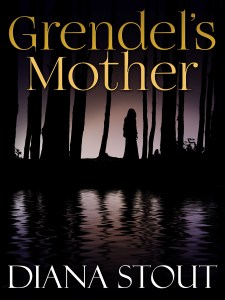
A reviewer responded to my novel, Grendel’s Mother, a book where I gave voice and a backstory to a character from Beowulf who previously had no voice. I stayed true to Beowulf and all incidents regarding Grendel, his mother, and Beowulf’s interaction with them.

Even someone who hasn’t read Beowulf can still read and enjoy Grendel’s Mother. It’s a stand-alone novel.

The reviewer’s comment essentially was, “I’d like to see a sequel.”

Say what? Did you actually read my story? Truly, an impossible feat considering the events at the end of my story. Because the review was online, I didn’t respond, as a good author shouldn’t.

As I was telling someone later about this comment, they said, “Well, couldn’t there be a sequel with Grendel’s children?”

I continue to be surprised.


Purpose: To share and encourage. Writers can express doubts and concerns without fear of appearing foolish or weak. Those who have been through the fire can offer assistance and guidance. It’s a safe haven for insecure writers of all kinds!

Posting: The first Wednesday of every month is officially Insecure Writer’s Support Group day. Post your thoughts on your own blog. Talk about your doubts and the fears you have conquered. Discuss your struggles and triumphs. Offer a word of encouragement for others who are struggling. Visit others in the group and connect with your fellow writer – aim for a dozen new people each time – and return comments. This group is all about connecting!


Risk-Taking Writers

The Insecure Writer’s Support Group

The question being asked this month for April 2021 is: Are you a risk-taker when writing? Do you try something radically different in style/POV/etc. or add controversial topics to your work?

Risk-Taking Writers

Something I’ve noticed over the years about writers and their writings: the more risks the writer takes, the better the odds of selling that work.

Even though publishers and agents say they’re looking for XYZ, which is usually the new and different story that’s become a blockbuster or best-selling sensation, wanting to ride the wave of popularity for that kind of story, what they’re really looking for is something that hasn’t been done before, because that’s exactly what that XYZ story has done

When I started writing Grendel’s Mother, I knew I was taking a risk. Purposefully. My vision was that Grendel’s Mother would be read in English literature classrooms, alongside Beowulf, and I saw Grendel’s Mother, too, as a commercial entity much like Clan of the Cave Bear. I was amazed how other writers with no real authority—meaning as publishers, purchasers of manuscripts—told me that I had to choose; it couldn’t be both. And yet, many of the current fictional bestsellers are both. Did they not recognize or understand the difference of literary books from commercials books?

I wrote and published it anymore. The readers are in two camps, most appear to like it. Some don’t, but then they didn’t like Clan of the Cave Bear either.

As writers, we take risks every day, exposing ourselves, even if minute pieces of ourselves, in our stories.

As writers, we take risks knowing we’ll draw both the fans who love our work and the critics who will tear it apart. Not liking some while others love it is pure human nature. There are lots of books that I don’t like, but I also recognize I don’t have to like everything. We’re not meant to agree on everything.

As writers, we take risks when writing against the norm, then being told by non-writers and specific genre writers that it can’t be done, whether it’s the subject matter, the POV, the tense used, or the type of character.

I do it anyway. I don’t listen to the noise.

I write what interests me. Some ideas are risky, some not; but I’ve noticed that the riskier the idea, the more excited I become about the writing.

Innovators are risk takers. Innovators push the boundaries, and an innovative writer will push the boundaries of genre, style, characterization, narrative, plot, and even punctuation. They follow their own vision regardless of trends.

It’s that how new trends start?


Purpose: To share and encourage. Writers can express doubts and concerns without fear of appearing foolish or weak. Those who have been through the fire can offer assistance and guidance. It’s a safe haven for insecure writers of all kinds!

Posting: The first Wednesday of every month is officially Insecure Writer’s Support Group day. Post your thoughts on your own blog. Talk about your doubts and the fears you have conquered. Discuss your struggles and triumphs. Offer a word of encouragement for others who are struggling. Visit others in the group and connect with your fellow writer – aim for a dozen new people each time – and return comments. This group is all about connecting!

Home

She looks at me like I’m old news. I’ve seen that look before, just before she got rid of her favorite high heels and those sneakers that had supported her forest walks and trips to the zoo. Unlike before when there used to be replacements, now their spots remain empty.  

At one time, I was untouched and unblemished, fully fur-line with bright, spunky fur that totally embraced her icy cold feet.

Now my fur is worn and flattened, disheveled as if caught in a bad whirlwind of a muddy storm. My insides are still warm and I’ll admit I’m tired, but I’m still functional. So what if I have a few worn-down spots? Inside and out. My soles are like steel now. Hardened and experienced.

She sighs every time she slips into me. Her worry lines disappearing. How can any replacement provide that same level of comfort? It would take any replacement months, probably even a year before they’d hear that same sigh.

Doesn’t she realize I’m home?

How can she throw away home?

A Necessary Evil: Feeding the Writer

A Necessary Evil: Feeding the Writer…with a Chicken & Stuffing Casserole

I’m one of those writers who wants to go into the kitchen and ten minutes later be eating a solid meal. Second to that, I’m good with a dish that I can cook and still be eating several days later.

While I’m a decent cook, it’s not my passion. Nor, do I like being in the kitchen every day. Every few days is my preference. Cooking for one makes that easy to do.

Now that I’ve been diagnosed with celiac (can’t eat gluten), with a long list of allergies that includes all dairy products, (No more butter? NO!), finding substitutes for my beloved pre-celiac dishes has been a challenge. Thankfully more companies are producing gluten-free and dairy-free products.

(I highly recommend Country Crock’s Plant Butter made from almonds. It spreads like butter and even better, it tastes like butter!)

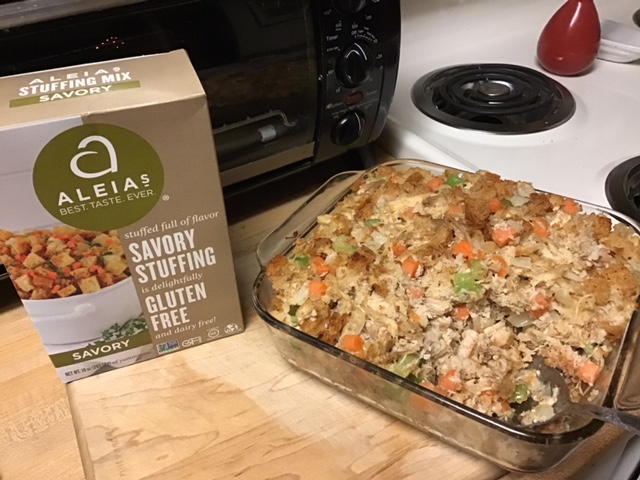
One such product that I discovered just before Thanksgiving was Savory Stuffing by Aleia. While I still miss the traditional crouton stuffing, this one tastes pretty good. Aleia has a box of plain stuffing croutons, as well.

I’m now using this savory stuffing, along with traditional stuffing ingredients and chicken to create a one-pan, one-dish meal.

The thing is, this recipe can work for anyone. Just substitute your preferred croutons and butter for mine, plus you can use more or less vegetables as desired. I like lots, so I actually use more than the recommended 1 cup.

My gluten-free, dairy-free recipe:

  • 1 box Aleia Savory Stuffing mix
  • 1 cup chopped carrots
  • 1 cup chopped celery (I’ve discovered I can freeze chopped celery!)
  • 1 cup chopped onion
  • 5 T Almond Plant butter
  • 1.5 cups of chicken – I use whatever is handy: canned or leftover cooked
  • 2 cups of chicken or vegetable stock
  • Salt & Pepper to taste

Melt the butter in a large frying pan. Saute the carrots, celery, and onion until the onion is translucent and the vegetables are tender.

Mix everything in a large bowl, until the stuffing is moistened and all is thoroughly mixed. Pour into a baking dish.

Bake at 350, covered with foil, for 20 minutes.

If you want a crispy crust, bake for about 15 minutes, remove the foil and bake for another 10 minutes or until top is crusty to your preference.

To serve up as leftovers, dish desired amount into a bowl, add some chicken gravy and heat in the microwave for about 1-2 minutes or until hot.

***

I had two bowls of this dish tonight, barely making a dent of the total amont. I now have leftovers for the rest of the week. And, I’m willing to eat this for both lunch and dinner if it means not having to fix anything else for the week, adding a salad here and there, along with eggs for breakfast. 

How about you? Do you have a favorite dish you like to make while you’re writing that allows you to forget about cooking for a few days?

The Reasons Why I Write What I Write

The Insecure Writer’s Support Group

November 4 question – Albert Camus once said, “The purpose of a writer is to keep civilization from destroying itself.” Flannery O’Conner said, “I write to discover what I know.” Authors across time and distance have had many reasons to write. Why do you write what you write?

The Reasons Why I Write What I Write

I write because I have to. I need to share. I need to express. I need to get it out of me—it being the need to vent, to give advice, to share something I’ve learned, or just to share a simple observation.

I write because I need to get all that stuff out of my head. The irony is that the more I write, getting it out, more of it flows in!

I write because I have people—characters—and topics, asking me, When is it MY turn? I’m surrounded by a crowd, all clamoring for attention.

My reasons for writing are that simple. So many ideas, so little time.

—

Insecure Writers Support Group BadgePurpose: To share and encourage. Writers can express doubts and concerns without fear of appearing foolish or weak. Those who have been through the fire can offer assistance and guidance. It’s a safe haven for insecure writers of all kinds!

Posting: The first Wednesday of every month is officially Insecure Writer’s Support Group day. Post your thoughts on your own blog. Talk about your doubts and the fears you have conquered. Discuss your struggles and triumphs. Offer a word of encouragement for others who are struggling. Visit others in the group and connect with your fellow writer – aim for a dozen new people each time – and return comments. This group is all about connecting!

How to Write When Struggling – Part 1

When struggling with characters, plot, interest, or the writing

In wanting to write a new blog, I started going through my TO BE WRITTEN file of blog ideas. I came across a copy of Maggie Doonan’s blog, “4 Signs It’s Time to Quit a Writing Project,” remembering how much I had originally disagreed with each one of those signs even though much of what she had to say was good advice. Those 4 signs in her blog are:

  1. You’re struggling to flesh out your characters
  2. You can’t get the plot to make sense
  3. You’re not excited by the story
  4. You’re finding writing harder than normal

I think in the beginning of my writing career that I might have agreed with that list but I rarely threw anything out. In thinking about my own writing career and projects that I started, put aside, and ended up working on later, I disagree with each one of those signs and here’s why.  

When struggling with characters

In the early days of my writing when there was no Internet, I submitted through the mail. One particular rejection that I still remember forty years later was that my characters were flat.

Having flat characters is a common problem for both new and experienced writers. My characters are always flat in the beginning. Why? Because I don’t know enough about them. Oh, I might know their hair color, height, their goal for the story, and the external conflict they’ll face, and possibly even an internal conflict, also known as their wound—usually emotional or psychological—but I don’t know why they have that internal conflict, that angst, that deep, dark wound that is buried so deep and is so secret that it drives every bit of their goals, words, and actions.

My job is to go digging. Or, as I call it: journaling. I write in first person as if I’m that person, writing a journal/diary entry. Usually, it starts with where *I* went to school, what I like to do, who my friends are, and by the time I’m into the second page—of a single-spaced document—I’m fully in that character’s head. I have become them. I’m able to feel their emotions and start asking questions as if I was a third person interviewer, How did you feel when that happened? What did you do? Why do you think you’ve hung onto those feelings all this time? And, so forth.

By the time, I’m done, I often have three-to-four full pages. I’m exhausted. But, I always discover that deepest, darkest secret they never want anyone learning. I learn how it drives every decision they’re making now. That secret/wound becomes their character arc, the thing they have to resolve before they can achieve their external goal, which will include getting the girl or guy if the story is a romance. If not a romance, it’s a toss-up whether the story will be bittersweet or happily ever after.

When struggling with plot

Generally, I discovered I was struggling with plot because I didn’t know my characters well enough. After all, without character, there is no plot. Their external goal drives their initial action(s), but it’s their internal wound that drives their reactions both in thought and deed.

If I was still struggling with plot after going back and digging deeper into my characters psyche, then I don’t have enough external conflict coming at them. I don’t have a conflict equal to their strengths and knowledge. Every main character has to have an adversary that has a great chance of taking that character’s goal away from them. Dealing with plot is all about heaping on the drama, the tragic events, the problematic people.

When I’m struggling with interest in the story

If I’m becoming bored with the story, it’s either because I don’t know my character(s) well enough or I don’t have enough drama blocking their way.

Plus, if I’m bored with the story, readers will be bored, too.

The only way to fix my characters is to work with them, digging deep into inner cores until I’ve fallen in love with them and want to be with them even when away from the computer because they’ve become more interesting than even my best friends.

If they can make me laugh, make me sigh, or make me cry, then that disinterest has disappeared.

I know I’ve succeeded falling in love with them when I forget to eat, lose track of time when at the computer, and when I wake up wanting to be at the computer as soon as possible.

When I’m struggling to write

I’ll admit that I can be a procrastinator, one who is highly side-tracked with the ring of new mail, seeing the number of notifications sitting in Facebook or Twitter. I can get lost in the rabbit hole of research of some new science, a moment in history I never knew about, or as in today’s news, the political scene, or the new numbers of this pandemic virus that has a stranglehold on most of us.

Generally, when I’m struggling, it’s because I’ve allowed myself to be distracted.

To create a better writing habit again, I now have an accountability partner. Most every day, we communicate by video or text where we set our writing goals, and then at the end of the day, we message each other, stating what we did, whether we met those goals or not. As a result, both of us are writing far more than we’ve done in the past.

Is there ever a time I leave a project behind?

Rarely.

Some projects have taken time. Grendel’s Mother, which I published in 2016, was a ten-year project from start to finish. For most of that time, in two different large chunks of time as in years, it sat on the shelf. The first time was because I was stuck with the plot. I discovered I needed to do more research. I went and reread Beowulf again and got some more ideas. The second time was because I’d returned to school for my last degree.

Another project was a children’s novel I had written. The story was cute, but not interesting enough. Also, it had been the first full novel I had written and served as a learn-as-you-go project. I wrote it when my oldest daughter was in fourth grade. Three decades later, she’s teaching fourth-grade and when helping me go through my shelves one day, she said that the characters were still memorable. At least I got that element right back then! Today, we’re planning on rewriting it together adding some sci-fi to the plot…someday.

There were two short-short children’s stories that I finally and recently tossed. The market just isn’t there for me. Plus, I wasn’t interesting in investing any more time in them.

Also, I tossed out a number of ideas that didn’t have any real writing behind them. They were just ideas and today, I have no enthusiasm for them.

My first romance ever written—the one where the characters were flat? I recycled the setting, leaving behind the characters and plot and wrote a different romance. Traditionally published in 1997, I revised and updated it, changed the cover, and the title from New Beginnings to Love’s New Beginnings, publishing it last year. The book got a 5-star review rating from Kat Henry Doran, the owner of Wild Women Reviews.

All this said, these past few months have not been normal. I, too, have struggled to write during March and April. Eventually, in May, I found my way.

My next blog will talk about how I’ve been able most of the time to overcome this unusual time as we cope with a dangerous virus. They may be tricks you can use both in the normal and abnormal times.

A Writing Dream

The Insecure Writer’s Support Group

July 1 question – There have been many industry changes in the last decade, so what are some changes you would like to see happen in the next decade?

A Writing Dream

Ideally, I would love to be able to think of a scene and that scene getting typed up grammatically correct and formatted perfectly just by my thinking it. Diction would be okay if I didn’t have to insert period, comma, new paragraph, and so forth.

Given all that, I don’t see it happening…

When I first started writing, I would read about various writing retreats – homes that had been turned into a permanent writer’s retreat, where a writer could come for a week, two weeks, or a month at a time and just write.

Ernest Hemingway had his own retreat in Key West. Something like that could work. Or, a castle in England, Wales, or Ireland; yes, that could work, too.

In my mind’s eye, though, I see a big rambling Victorian-like house with a large wrap-around porch, with someone cooking the meals, someone else cleaning the rooms, gardener, and general maintenance person. And best of all, a setting that I’d never get tired of. Mountains in the background, a lake, large river, or even an ocean in the foreground, with the house up on a bluff out of rising waters’ way.

All I’d have to do is mentor, teach, and write.

Yup, if I ever become successful enough where I’m able to have my own private retreat and a writer’s retreat where I could teach and pay forward everything I’ve ever learned and bring in other writers to teach…that would be ideal. The last thing on my bucket list.

Of course, you did notice that my literary success has to come first, right?

Posting: The first Wednesday of every month is officially Insecure Writer’s Support Group day. Post your thoughts on your own blog. Talk about your doubts and the fears you have conquered. Discuss your struggles and triumphs. Offer a word of encouragement for others who are struggling. Visit others in the group and connect with your fellow writer – aim for a dozen new people each time – and return comments. This group is all about connecting!