
Tag Archives: writing-tips

Dead Zones – Getting Stuck Writing Stories

(This blog post first appeared as “Dead Zone: The Sagging Middle” on the Writers in the Storm blog on May 13, 2026.)

You’re halfway through the story, and you’ve entered the dead zone. The sagging middle. Where great ideas weaken.

The Three Biggest Reasons for the Sagging Middle

  1. Nothing is happening.
  2. The climax is in the wrong place.
  3. There’s a lack of emotion.

What Should Occur in the Middle?

Blake Snyder, author of Save the Cat!, a book about screenwriting, calls this plot point the Midpoint.

According to Michael Hauge, author of Writing Screenplays That Sell, Selling Your Story in 60 Seconds, and The Hero’s Two Journeys with Christopher Vogler, the Midpoint is one of five major plot points in the story that is designed to “elicit maximum emotion” both from the character and the audience.

This middle plot point should spin the story in a different direction and be fraught with anxiety, frustration, self-doubt, or fear.

Different writers have called this particular plot point by different names, but they all mean the same thing: it occurs in the middle of the movie or the book at the 50% mark.

For Michael Hauge, this plot point marks the Point of No Return. The main character can’t return to the Ordinary World from which they came. Bridges have been burned. They’re now closer to the end of the story than they were at the beginning, and they’re no longer that same person.

Chris Vogler, author of The Writer’s Journey, calls this plot point the Approach to the Innermost Cave. It’s both a huge step into the heart of the conflict and the heart of the character’s wound.

James Scott Bell, author of Write Your Novel From the Middle, coined this potent Midpoint as the Mirror Moment. He contends this Mirror Moment is a self-examination within a scene, where the character fully recognizes they can’t go back.

This Midpoint is a highly emotional scene as we see the character wanting to change, with the plot moving forward because of their renewed resolution in changing, which spins the story in a different direction.

How to Fix the Dead Zone

So, how do you fix this dead zone? First, recognize the problem:

  • Nothing is happening.
  • The climax is in the wrong place.
  • There’s a lack of emotion.

Next is the fix:

  • For the nothing is happening problem, make something dramatic happen. Where the character must face their own actions and decisions solidly and alone for the first time.
  • When the climax is in the wrong place problem, move the action/event to the Major Setback / Dark Moment location (75% mark). Then, go back and fix the mid-point as suggested in the previous bullet.
  • When there’s a lack of emotion problem, let us see the character’s emotions as they’re forced to examine their previous actions, behaviors, and decisions. This is the Mirror Moment. The reason why we read books and watch movies. We want to experience what the protagonist is feeling. If this is a sagging middle/dead zone, that means there’s not enough emotion. Let us see the character in emotional pain. Their wound is on the surface, and they’re being forced to deal with it.

Conflict generates pain, which generates emotion. So what was the major conflict that brought the character to this mid-point examination?

Ratcheting the Emotion

To fix the sagging middle, you want to ratchet up the main character’s emotion with tension, danger, stress, and anxiety. They need to be in danger emotionally, physically, mentally—separately or together.

To fix the Lack of Emotion Problem – Layer the story with more emotion.

  • Hurt your main character.
  • Fill every scene with emotion.

Allen Palmer named each of Christopher Vogler’s 12 plot points from The Writer’s Journey with a specific emotion. Seeing those named emotions, for me, was key to understanding how to layer those plot points more effectively, more deeply.

Far too often I’ll hear a writer, especially a romance writer, say, But I don’t like hurting my characters! Hurt them to the point that you’re cringing or fearing for them.

*****

A sagging middle is a sure sign that something is wrong with the Midpoint plot point.

By brainstorming more events, more pain, more emotion, and moving your plot points around until you feel a lump in your throat or any other emotion you’re trying to elicit, your audience will feel it, too.

This is why I spend time plotting my story before I begin writing, so that I won’t get stuck in the sagging middle. Before I became a rabid plotter, I got stuck in every story at this important plot point. Every time. Not anymore.
Is Negativity or Fear Killing Your Creativity?

Writers tend to burrow into negativity and fear. I see and hear both displayed every day.

  1. “I’m no good. I keep getting rejected.”
  2. “Why is she getting published, and I’m not?”
  3. “AI is horrible. It’s ruining our business.”
  4. “I don’t want to learn how to use a new program.”
  5. “I want to be traditionally published, so they can do the editing and promoting.”
  6. “How am I supposed to deal with crappy ratings?”
  7. “I have to write every day?”

Writers, like people in any other field, tend to repeat what they hear without researching if the information is true or not. Why? Because what they’re hearing falls into what they’re already thinking. Consequently, they create their own self-destruction, spiraling down into more fear or negativity. No wonder they feel

1.Rejections are a normal part of the process. They’re never personal. Maybe your writing does need improvement, but the odds are, your book wasn’t a good fit for them. It’s like shopping for clothes. How many do you try on before you find the one that’s the best style and fit?

      Their goal is to buy the best book possible—the one they know their readers want. They get tens of thousands submissions to choose from.

      2. She got published and you didn’t because she was in the right place, with the right material, at the right time. It’s happened to me twice. It’s happened to other writers who say the same thing. A lot of it is plain luck where preparedness meets opportunity.

      3. AI isn’t horrible. It’s a tool. Just like computers (an AI device) took over typewriters. Like the automobile (another AI device) did for the horse and buggy. They’re all different degrees of AI. It’s a tool that can’t write anything without human intervention. 1) It’s not creative, 2) it spits out only that which you feed it, and 3) it doesn’t have a voice; it’s dry and technical.

      That said, AI is great for brainstorming ideas, for creating promotion blurbs, creating graphics, or coming up with title ideas, finding mistakes.

      4. In not wanting to learn, you’re telling agents, editors, and publishers that you’re not open to criticism, making changes, or wanting to improve. Lean into the learning of what editors really do, the process of books getting published, as an agent, various tools, untried social media, more of the craft of writing especially in other genres, and so forth. Be open to change.

      5. In today’s market, unless you’re a big name, you’ll be promoting your own work regardless if the book is traditionally or indie published.

      6. Agents, editors, and publishers want polished material. Grow your editing and formatting skills.

      7. A bad review isn’t personal. Any review is really about the reviewer, not you. It’s a peek into their likes, dislikes, temperament, and preferences. It’s an opinion, and we all have them. Aren’t there books you don’t like?

      8. Read about writers, how they began, how long it took to become published, their writing habits. Follow their examples.

      Becca Syme, author and owner/coach of the Better-Faster Academy, said in a newsletter, which tapped into a keystone truth of mine, “Fear is meant to move you, not stop you.”

      I would add that negativity always spirals downward. Avoid being negative. Whatever you tell yourself or think, your subconscious believes. It doesn’t know the difference between what is real and not real.

      As I look back over my long career of writing, I’ve had a lot of unknowns, barriers I had to cross and overcome, lots of failures, of rejections, of not making the cuts I had to cross and overcome, lots of failures, of rejections, of not making the cut.

      I learned to work through the failures, to consult with those who had more knowledge, more experience. I read the magazines, the blogs, and the books. I asked for tips on how to succeed and then applied them, even if I disagreed with them at the time. In doing the work, I found they were usually right.

      Be willing to fail, to be rejected. Keep submitting anyway.

      Welcome the critiques, to hear what others think is wrong. It’s the quickest and best way to improve. MFA classes are critique workshops from your peers. You don’t get to get angry and cut them out of your life; you learn to ignore their opinion. However, if two or more are saying the same thing, pay attention!

      Be original, which is guaranteed to attract naysayers.

      Stop comparing yourself to other writers. You’re comparing apples to oranges. Always.

      Every successful writer has failed along the way. All of them.

      Success is built on failure.

      Success is built on practicing. Every. Day.

      Every successful writer was once a beginner, wading into the unknown, and learning how.

      Every successful writer was at one time unknown.

      Confront your fear. Smash it, tame it, remove it, or simply go over it.

      Live for the journey.

      That’s how you overcome the fear and leave the negativity behind.

      —

      Join my two-week master class, Finding Your Writing Fire & Keeping It Hot June 9-20, 2025.Limited to 25, it’s a class that will show you how to get the flow going again, how to rekindle the passion you felt when you began the project, how to get unstuck, where to find accountability, how the Universal Laws can help or hinder, and more.Built on lessons from my, Finding Your Fire & Keeping it Hot book, this class focuses on your writing and brings the joy of writing back into your life again.

      Have you subscribed to my announcement-only newsletter? Click here.

      Best-ever New Thesaurus Is Here! (+ Giveaway)

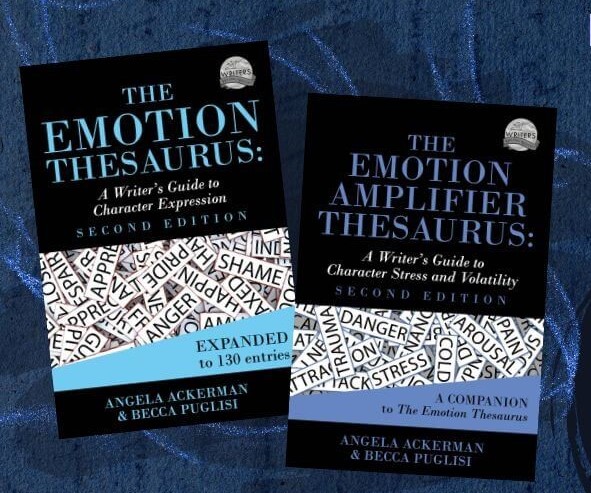
      I’m sharing Angela Ackerman and Becca Puglisi’s big day! The Emotion Amplifier Thesaurus: A Writer’s Guide to Character Stress and Volatility has just released, and as part of the Street Team, I’m helping to get the word out about a HUGE giveaway Angela and Becca are running to celebrate!

      This guide is a companion to the popular Emotion Thesaurus and covers all the ways to push a character emotionally, setting them up for BIGGER reactions.

      Emotion Amplifiers are specific states and conditions that can strain a character to the point they lose control. Pain, exhaustion, arousal, and competition are just some of the amplifiers that can send your character over the edge. If they give in to what they feel, they might lash out, take foolish risks, show poor judgment, and act in ways that take their situation from bad to worse. Hello, conflict!

      Win A Free Workshop!

      Amplifiers can bring a character’s emotions to the surface for readers to see, which is exactly what we need to happen. But that’s not all they do. Becca and Angela can’t wait to dive into how they can power a story and are celebrating this release with a very special Zoom workshop.

      100 Seats Are Up for Grabs!

      If you’ve ever attended a workshop by Angela and Becca, you know you’ll learn a ton. Head over here to enter the giveaway, but hurry – the last day to enter is May 17, 2024.

      Good luck!