
Tag Archives: Goals

Making a Difference

Have you ever uttered, “Why bother? It won’t make a difference,” or something like that?

Yeah, I have. Lots of times.

When I started writing and putting my work out in the public forum, I figured few would read my writing, but make a difference? Nah.

Every now and then, a person here and there would contact me via the phone or USPS (pre-Internet), telling me how my published piece affected them that day. As a blessing. As something they needed to hear. As something that made them think. As a reminder. Or, as pure entertainment that took them away from their problem(s) for a bit of time.

I didn’t think too much of those incidences as they were few and far between, though they did make me smile, and I’d put them in my scrapbook. I still didn’t believe I was making a difference. Me? From small town U.S.A.? Who the heck was I to think I could make a difference?

Years later, I started teaching. I watched as students became unblocked. They told me how they were loving writing again or loved writing for the first time ever. That they now understood grammar and punctuation better. Or, how the teacher from grade school or high school who had told them that they’d never be a writer had done them a disservice.

Because of an earlier experience during my bachelor’s degree where I was shown that I was plagiarizing, despite what I had been taught in high school, I became more and more interested in the subject, discovering it was huge problem but little publicized. I started teaching my students on how to avoid plagiarism because I saw them making the same mistake I had made. I wanted plagiarism to never be an issue for them, because not knowing was never an accepted excuse; being accused of plagiarism had and still has dire consequences.

At the time, I had a co-worker who said about my focus on helping students avoid plagiarism and taking the concern university-wide, “Why are you trying to hard? It’s not like you’re going to change the world.”

I forged ahead anyway, because I cared.

My students showed me I was making a difference via their papers. They told me, too. At least, I was making a difference in a small area of the world: my classrooms.

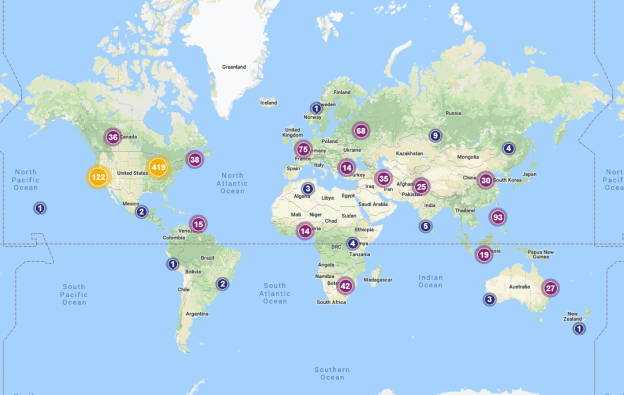
And then later, I graduated with my last degree having written a dissertation, Teaching Students About Plagiarism: What It Looks Like and How It Is Measured, that I chose to make as a free publication, because of the research discovery I made regarding two major studies. One study was pre-Internet, the other post-Internet, where the percentage of actual plagiarism had not changed, which countered those who said the Internet was to blame. That discovery begged the question that became my book’s topic. In publishing the book, I asked to received a monthly summary of its activity.

The book was published in June 2013. To date it has been downloaded 1,499 times to 246 different educational, commercial, organizational, governmental, military, and library institutions in 81 different countries across both North and South America, Europe, Asia, and Australia.

Had I not requested that monthly summary, I would have never known the extent of its reach.

Have I made a difference? I’d like to think so, both as a writer and as a scholar in this case.

Believe it or not, we all make a difference, regardless of our field of work or where we live: as parents, teachers, military, fire, police, utilities, clerks, assistants, medical, artists, entertainers, rescue, therapists, non-profits, neighbors, communities, and as citizens.

We ALL make a difference and in many different ways throughout our individual lifetimes.

One of the ways where I’ve made a difference just happens to show up on a world-wide map.

So, to those of you who have others trying to stomp on your dreams, your ambitions, your goals, your work…

Ignore the noise and follow your own path.

A New Year Means New Opportunities: But Wait It’s February Already!

Okay, I admit it, I’m a bit behind. But since there’s a meme on Facebook that says January was a practice month, that 2019 started with February, I’m on time!

Because it is the new year, it’s time to talk about goals. Or rather about goal-making.

Not successful at achieving your goals? Maybe I can help.

The SMART goal approach is becoming a hot item among writers; well, at least with two, Maris Soule and Diane Burton I know through my writer’s group, Mid-Michigan Romance Writers of America (MMRWA). In fact, both recently blogged about making 2019 goals using the SMART method.

I learned about SMART goals when I taught English classes at Davenport University, a business college. Our students saw the SMART goals methodology used in most of their classes. All the committees I worked on used them, too. In those committees, spreadsheets were used to identify and then track our goals.

Is it any wonder I learned to love spreadsheets? Well, actually, no. I was already in love with spreadsheets before my academic employment. My love for spreadsheets occurred when I was working at W.K. Kellogg Institute for food & nutrition research, where I was a liaison between the cooks there and the procurement department at Kellogg headquarters. I had a wonderful supervisor who taught me how to create cell formulas and create pages that talked to each other. Some of those skills I was able to teach to my academic peers, and now I continue teaching those skills to my writer friends.

I’m big on goals. So are Tony Robbins, Wayne Dyer, and Norman Vincent Peale. These three men, through their books which I read in my 20s, showed me the value of having SMART goals, even though they weren’t called SMART back then. Well, at least, not in their books.

I’m a fan of making to-do lists, too. Daily ones. So, naturally, my goals end up on my daily to-do lists. I have a master lifetime list of goals, a yearly list, which then gets broken down into monthly, weekly, and daily goals.

Do I achieve all these goals? Heavens no. But, here’s the secret. Because of these lists, I achieve way more than I if I didn’t have goals or the lists.

Only when I start getting specific with the weekly and daily tasks is when I start crossing off items. The more items I cross off the list, the more I want to do. It’s truly addictive. And, there’s something magical about writing the goals down. If you’re already a list maker, you already know the best part of any list is crossing it off the items. It’s a rare day, though, when I cross off all tasks.

So, what is the SMART goal?  It’s an acronym for:

Specific

Measurable

Action Oriented

Realistic

Time Bound

SMART goals are why I love our writing group spreadsheet so much, because it’s a way to Measure the Specific, Time-Bound, Action-Oriented, Realistic, monthly, writing goals we individually set up. I use present tense verbs, or as infinitives (To + Verb) when writing the goals:

  • To finish editing [book title]
  • To clean out files
  • Research [book title]
  • Write one chapter of [book title]

I then take those goals and break them down into daily, sizeable chunks, doable in 10-15 minutes, others in an hour or so and place them in planner’s calendar. In the years I’ve been doing this, there’s only one month where I completed all the goals. Most of the time, I feel good to accomplished half of them.

Without the spreadsheet, without the SMART goals, I wouldn’t be doing much. Yup, I’m that lazy. That forgetful. Get that sidetracked. I refer to my list multiple times throughout the day.

Bottom line, it really doesn’t take a new year to create new opportunities. Each day is a new opportunity to start a SMART goal, even at 11:55 p.m.  After all, a lot can be done in five minutes. Such as creating a goals list for the year.

So, what are my goals for this year?

  • To republish two of my first three books published. The first one, Determined Hearts, is already published.
  • To plot out the four remaining novellas in my Laurel Ridge novella series. The first one, Shattered Dreams, is published. #2 & #3 have the first drafts written. Ideally, I’d like to write the first drafts for the remaining four, then start publishing them at the end of this year and next.
  • To edit 2-3 screenplays and publish them. My first screenplay, David & Goliath is already published.
  • To sort materials for writing how-to series
  • To plot out a historical (can’t decide if as a novel or a screenplay)
  • To write quarterly blogs (A huge improvement over last year’s few postings)
  • To schedule on calendar promotional days throughout the year. DONE!!! (On these days, I’ll spend creating Facebook, Twitter, and Pinterest promotional posts and/or ads. During 2018, I recognized I was doing promotions 80% of the time, writing only 20%. I want to flip those percentages.)

Actually, I do have a few more goals, but you get the idea. And you can see how I cross them off and write DONE at the end of the line. It’s both thrilling and fulfilling to write DONE.

And, that’s what this blog is: DONE! One-quarter of the way done for this quarter’s blogs.

So, how about you? Do you use SMART goals? Does this blog make you want to try using them?