Creating a Cover

For the past month, I’ve been involved with designing two books covers, or rather, I’ve had two different cover designers creating them for me.  In both instances, I had an original vision, but in one instance, I had created an earlier cover myself and tried to go forward with that design.  Thus, that’s the journey I report here.

Once upon a time, I published a book that I titled Fuss and Feathers.  I loved that title.  She was the fuss and he was the feathers, but the editor didn’t.  As a result, Fuss and Feathers became

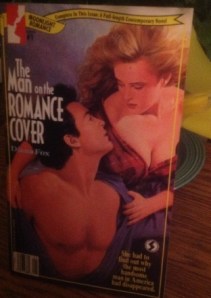
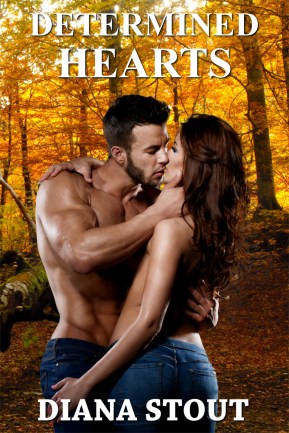
The Man on the Romance Cover 2The Man on the Romance Cover, and it became the first book to launch the new line of Moonlight Romance by the Starlog Group, creating a romance book in a magazine format.
Personally, I hated the title.  I hated the cover, too.  As the author, I had no artistic control over either.

While the characters matched the faces I envision—after all I had sent magazine ad tear sheets of what I imagined these characters to look like—I didn’t imagine them in this state of undress . . . especially her.

That was the era of bodice rippers.

Then, I got my rights back but was busy with school—writing papers for classes, teaching, and fulfilling my role as administrator—so, the book got shelved for the time being.

Then self-publishing became easier to do.  I thought, why not?  The story was still good.  I’d have to change the cover, due to not owning its copyright, and I wanted to change the title, anyway, along with my name and getting rid of the previous marriage pseudonym.

So, the new book with a new cover became

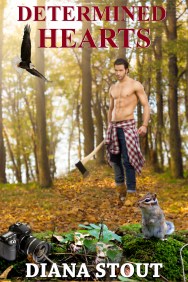
DH Diana's front coverDetermined Hearts.

At the time, I liked the cover.  I spent time learning new software and probably should have spent more time with the software.  I published it on Smashwords hoping for the best.  Unfortunately, there were no sales.  Nothing.  Of course, I wasn’t promoting it, and now that I think back on it, I can say my not liking the cover probably influenced my lack of promotion.  Consequently, I unpublished it.

Which brings us to February 2016.

I was ready to do the book justice.  The story was still good after I re-read it, at least in my opinion, though it did need updating and having errors that six other editors didn’t catch, fixed.

I contacted a designer, telling her that I wanted to put my hero in the background and possibly add a camera, placing it on the rock.  After all, the chipmunk, camera, and eagle were featured in the book, so why not?

We ended up with this:  Determined Hearts - Cover Final High Resolution

While said I was okay with the image as it had been my vision and we’d gone to a LOT of trouble finding the right body and matching it with a different head (the wonders of artistic manipulation!), there was something not right with the picture.  And, I couldn’t determine what that something was.

I knew the eagle wasn’t right, nor the camera, despite how many times we tweaked it and how much I wanted them there.  Even the bright light in the background bothered but I couldn’t say why.

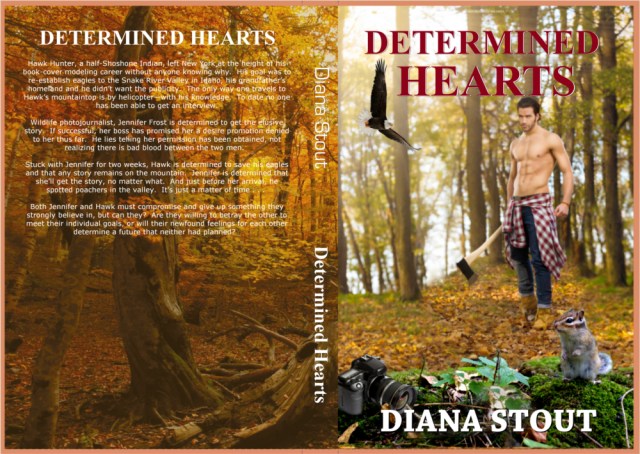
And then, I saw the entire flat – the back and front cover combined, with the designer having chosen the back cover landscape. (But yeah, overall, it doesn’t look good, does it?)

Determined Hearts Full Cover - Flat with old ebook cover

Immediately, I knew what was wrong.

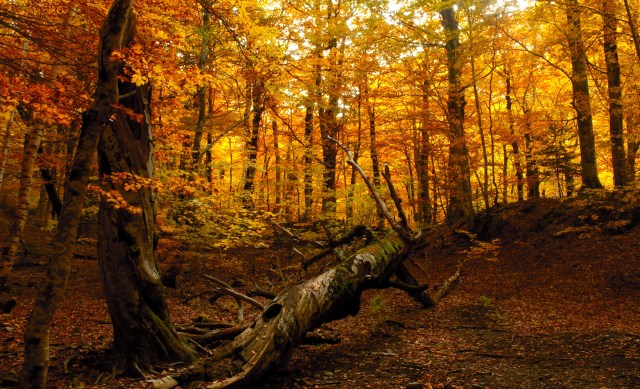
The back didn’t match the front and I loved, loved, LOVED the back cover landscape.  The front cover landscape was okay, but I loved the other more.

And then, she showed me the entire flatWooded Scene

and I was enamored.  This was my cover!  By now, we were both giddy about the future composition.

I wanted him placed on the front cover still, but up in the trees, reducing him in size.  We decided to place the chipmunk on the log.

Determined Hearts - Prototype Cover 2 (5)

The result:   A man who looks like he wants to ax murder a chipmunk!!!

(Are you laughing yet?)

I still laugh every time I look at this picture.  In all honesty, I can’t blame the designer.  She was following my wishes, my design.  Actually, she must have been cringing all along the way, wishing I wasn’t so stuck on my choices.

The landscape still looked good, but my hero had to go.  He was starting to look too angry, with an ax to grind.  (Groan.)

I needed a different hero.  In fact, I decided that the cover needed a couple.  The designer liked that idea.

I sent her a picture that I absolutely loved, asking if it was possible to use them on the cover even though they didn’t have legs showing and the fact that her hair was auburn rather than the blonde tresses that my original heroine was born with.

The designer sent me this. Determined Hearts - 1600 Cover eBook Final

Immediately, I knew this was my cover.

It was far easier for me to change the color of her hair within the pages then it would be for us to try tweaking the image.

And so, the cover was finished.

What a journey.  Probably close to 100 e-mail exchanges over several weeks, but we finally arrived a final product.

Behind the scenes, for any author who is self-publishing and working with a cover designer, there are a lot of decisions that go into creating a cover.  And, it’s always a collaboration—not always an easy one, but one that is totally worthwhile when the results are this fabulous.

Oh, and now we’re into the era of embraces and washboard chests.  I’m okay with that.

Update:  Determined Hearts is available for sale.


Posted in Covers, Publishing books, Uncategorized | Tagged , , , , , , | Leave a comment

Error-Free Writing

When I made the decision to leave academic teaching and become a full-time writer, I knew the days would be long.  I had this vision that I would be writing new prose every day.

Now that I’ve been at this new full-time career for more than a month, the only new prose I’ve written has been for my blogs, writing up reviews and comments for others, and revising book blurbs.

The biggest project I’ve taken on has been to edit two of my books that I’m getting ready to publish.  Moreover, I’m finding that editing a book, any book these days, takes days rather than just hours.

The downside of any writing is that no matter how many hours one spends looking for errors, there will always be a few escapees.  Such is the case regarding my soon-to-be-republished book, Determined Hearts, which was first published in 1994 as The Man on the Romance Cover.

At that time I wrote The Man on the Romance Cover, I had no formal schooling in writing.  I was a self-taught writer depending on my high school education of grammar and punctuation, which was better than most as I’d had a wonderful shorthand teacher–yes, shorthand.  We not only had to punctuate our work properly, but when reading back the text, we had to include the punctuation and state what rule it follow:  introductory comma, conjunction comma, and so forth.  As a result, I learned more about punctuation in that class than I ever did in any of my English classes.  (Thank you, Mrs. Rhinehardt!)

The Man on the Romance Cover was published via a traditional publisher, with the traditional line editor(s).  In fact, that book went through half a dozen different readings by as many individuals.

Rereading the book last summer, I found that the story still stands.  Since I had rights to the book, I decided to reprint it.  The downside is that I found errors.  So, I fixed them.  Or, so I thought.

Having removed the book from Smashwords where it had been published since last summer, I just spent the last two days rereading the book.  Oh, the errors that I found.  I’m chagrined to think that I had this book for sale with all those errors, still.

In another week or so, it’ll be up on Amazon and available as both an eBook and print copy.  I’m doing my best to make it error free.  But guess what?  I’m only human.  I’m sure there will be an error somewhere that some reader will find and will want to pull out their red pencil to mark.

I hope I’ve done a better job this time, but if not, do me a favor.  Should you find errors in my work, send me an e-mail.  I’m human enough to want to fix them and make your reading pleasure, well, more pleasurable.

Posted in Errors when writing, Publishing books, writing | Tagged , | Leave a comment

Part II – Genesis & Development of Grendel’s Mother

The choices I made and why.

So, I had an idea for this book, Grendel’s Mother, and I had 20 or so pages written.

I knew how my story started, and I knew how it would end, but I had only a vague idea about a few special events in the middle.  During the next few years, I would add scenes that I would write out and then file away.  I’d jot notes on napkins, scraps of paper, and on the backs of bookmarks.  Everything went into a file folder.  Then, in 2006, I took all these bits of scenes and dialogues and strung them together, and developed a detailed outline.

I worked on her characterization: her dreams, desires, fears, and flaws.  I knew she would be young.  At first, I had her as fourteen, but then realized that would be too young, so I made her fifteen.  She was a precocious creature, thinking the rules didn’t really apply to her.  Consequently, that thinking always got her into trouble.

In 2009, I began my Ph.D, so once again, all creative writing came to a halt while I wrote academic papers.  With my Ph.D. in hand, I had to make a decision: would I continue writing academically or would I return to my creative writing roots?  I couldn’t do both while working full-time, with most of my time spent teaching, grading papers, and as an administrator for the English Department.

I choose creative writing with the support of my supervisor.  In earnest, the draft writing began.

The writing was not easy.  I found myself jumping from first person to third person but predominately, I was writing in first person.  Which should I use?

I was using both present and past tense.  Again, I found myself asking, which should I use?

I decided not to make a decision until I completed the first draft.  In the end, the book became a first-person, present-tense story, except for a brief period when Grendel’s mother goes back in time, which starts in past tense and then evolves into present tense again because the story brings that back story into the present.

While I had given this character a name, I realized mid-way through the first draft that her name hadn’t been used.  Should it be said?  Was it necessary to know her name?  I ended up naming her but her name is never mentioned in the story.  I chose this route deliberately, even when as a child, Grendel asks his mother what is her name?  She tells him to call her what he always has—Mother.

My outline didn’t include Beowulf characters, not until   Grendel becomes a teenager and starts fighting Hrothgar’s thanes.  While Hrothgar is mentioned early in the story, the others—the thanes and Beowulf—don’t appear until Grendel tangles with them.  In the end, this story is a stand-alone tale of a woman who stands alone, as the only daughter in a large family of brothers, as an outcast from her community, sacrificed to a dragon, and who creates a home in the wilderness, becoming one with Nature, where she gives birth and raises her son.

A reader doesn’t require prior knowledge of Beowulf to understand the story, and yet the story is made richer with that knowledge.  Because I was concerned about readers not having prior Beowulf knowledge, when I was looking for Beta readers, I chose one reader with no knowledge, one with some, and one who had good knowledge of Beowulf.

In the end, all three readers agreed:  it didn’t matter if the reader had Beowulf knowledge or not.

Interestingly enough, the reader with no knowledge has since gone out and purchased Seamus Heaney’s translation in her desire to know more about the epic poem.

Purposefully, I designed this story as a literary and commercial work of art.  While literary, it can easily rest on a traditional mainstream bookstore shelf.  My desire was to craft a story that would appeal to audiences of both young adult, new adults, and adults in general, much like The Maze Runner, The Hunger Games, The Divergent series, and others books have achieved.

So how long did it take me to finish that first draft?

Once I made the determination that I would finish it as soon as possible, with the help of both in-person and virtual write-ins that I attended, I was able to complete the first draft, revised it, and polish it in just a few months.

It was during my writing of Grendel’s Mother that I learned that Beowulf was J.R.R. Tolkien’s inspiration for The Hobbit, that George R. R. Martin’s, The Game of Thrones series was inspired by Tolkien.  And, I have to imagine that many works of today’s fiction and TV series were similarly inspired.

Posted in The creation of Grendel's Mother | Tagged , , , , | 1 Comment

Grendel’s Mother: Its Genesis and Development

Part I: The Genesis

There is no question about this project: it was huge.

The initial idea was huge.  The fact that I wrote 20 pages that same night in an hour’s time was huge.  In fact, those pages were the first major creative writing I had undertaken in four years.  Up until then, most all of my writing endeavors were driven by the college classes I was taking.

The fact that it took me ten years to write the book was huge, as were many of the events that interfered with its writing:  my college education, starting a new career field, the deaths of my father, my sister, and then my mother.

Once I was able to return to my creative writing, I knew finishing this book was central to my continued success as a creative writer.  At the time, I vowed I would work on nothing else, creatively, until this book was finished.  I kept that promise.

I kept that promise.

As much as I wanted to work on other projects, I knew my next career move, which would be full-time writing, was based on my finishing this project that had been consuming me for a decade.  There wasn’t a day when I wasn’t thinking about it, how it would be a great book for high school or college classrooms.  How readers would have a different perspective on the oldest Old English written story.  How I could give a voice to a woman who had no voice in the original literature and who was talking to me loudly nearly every day.

And so, late in 2015, the book was completed – a major dream, a major goal.  That achievement was a major event because the writing was not easy and the journey was fraught with obstacles.

In the mid-90s, following that success of writing and publishing several romances, I became a screenwriter where I was working with a handful of producers who wanted to see everything I wrote.  As they told me, they loved my writing.  Now it was about finding a good fit with my ideas.

Instead, my life and my work took a hundred-and-eighty-degree turn.  A divorce had me entering the workforce full time, but I no longer wanted to work in an office or perform bookkeeping, both of which I’d done my entire adult life.  While I was good at both jobs, they weren’t my passion.

Several events and almost two years later, I entered college, starting with my associate degree.  As a result, I was writing all the time.  I watched as my thinking changed about classical literature, including poetry; and then, the first class into my bachelor degree changed my thinking in a major way.  The class, part of the medieval program at Western Michigan University was “Heroes and Villains” where I encountered Beowulf for the first time.

The Graduate Teaching Assistant, Rhonda McDaniel, who was my teacher was delightful.  She challenged my ideas and cheered me on all at the same time.  We had many engaging conversations both during office hours and in class.  Because of Rhonda, I wanted to pursue a minor in Medieval Studies.  I would lack that achievement by one class, but in my heart of hearts I became a medievalist and still am.

I would study Beowulf twice more, both times with different and engaging professors.  Today, Beowulf is still one of my favorite books.

It was after these studies of Beowulf and as I began my third year of my master’s degree in creative writing, that I began teaching a Women’s Studies survey course, where we discussed women’s issues including books written by women or with a woman as a protagonist.  A major recurring topic was how women did not have a voice in many instances in history or in literature.  It was that thought during that fall 2006 semester that I realized Grendel’s mother had no voice.

All day I thought about her.

That night I sat down, in an hour’s time, I wrote the first twenty pages.  I ignored everything to do with proper and grammatically correct writing and watched as the words poured from my fingers, through the computer keys, and onto the pages.

The euphoria I felt afterward was incredible.  I’d found the zone again, not realizing how much I had been missing it.

Those pages became the genesis, which I titled that night and it’s a title that has not changed: Grendel’s Mother.

 (to be continued Part II – The Development of the Story: The Choices I Made and Why)

Posted in The creation of Grendel's Mother | Tagged , , , , | 2 Comments